
Demographic models predict end-Pleistocene arrival and rapid expansion of pre-agropastoralist humans in Cyprus (pre-print)
Our paper “Demographic models predict end-Pleistocene arrival and rapid expansion of pre-agropastoralist humans in Cyprus” is available as a pre-print from Research Square, a preprint platform aimed to make research communication faster, fairer, and more useful. You can access it following this link: https://doi.org/10.21203/rs.3.rs-3468157/v1.
All code and data are available at github.com/cjabradshaw/CyprusHumanPleistocene.
Abstract
The antiquity of human dispersal into Mediterranean islands and ensuing coastal adaptation have remained largely unexplored due to the prevailing assumption that the sea was a barrier to movement, and that islands were hostile environments to early hunter-gatherers (Cherry & Leppard 2018; Leppard et al. 2022). Using the latest archaeological data, hindcasted climate projections, and age-structured demographic models, we demonstrate clear evidence for early arrival (14,257 to 13,182 calendar years ago) to Cyprus, and predicted that large groups of people (~ 1,000 to 1,375) arrived in 2–3 main events occurring within < 100 years to ensure low extinction risk. These results indicate that the post-glacial settlement of Cyprus involved only a few large-scale, organised events requiring advanced watercraft technology. Our spatially debiased and Signor-Lipps-corrected estimates indicate rapid settlement of the island within < 200 years, and expansion to a median of 4,000–5,000 people (0.36–0.46 km− 2) in < 11 human generations (< 300 years). Our results do not support the hypothesis of inaccessible and inhospitable islands in the Mediterranean by pre-agropastoralists, agreeing with analogous conclusions for other parts of the world such as the Indo-Pacific (Bird et al. 2019; Bradshaw et al. 2019). Our results also highlight the need to revisit these questions in the Mediterranean and test their validity in light of new technologies, field methods, and data. By applying stochastic models based on both temporally and spatially explicit data for the first time to the Mediterranean region, we are able to place Cyprus and large islands in general as attractive and favourable destinations for palaeolithic peoples.
Mechanisms of hunting native megafauna to extinction by Palaeolithic humans on Cyprus (pre-print)
Another paper deriving from work conducted in the context of project MIGRATE entitled “Mechanisms of hunting native megafauna to extinction by Palaeolithic humans on Cyprus” is available as a pre-print from Research Square, a preprint platform aimed to make research communication faster, fairer, and more useful. You can access it following this link: https://doi.org/10.21203/rs.3.rs-3889827/v1.
All data and R code necessary to repeat the analyses available at github.com/cjabradshaw/CyprusHippoElephant.
Abstract
The hypothesised main drivers of megafauna extinctions in the late Quaternary have wavered between over-exploitation by humans and environmental change, with recent investigations demonstrating more nuanced synergies between these drivers depending on taxon, spatial scale, and region. However, most studies still rely on comparing archaeologically based chronologies of timing of initial human arrival into naïve ecosystems and palaeontologically inferred dates of megafauna extinctions. Conclusions arising from comparing chronologies also depend on the reliability of dated evidence, dating uncertainties, and correcting for the low probability of preservation (Signor-Lipps effect). While some models have been developed to test the susceptibility of megafauna to theoretical offtake rates, none has explicitly linked human energetic needs, prey choice, and hunting efficiency to examine the plausibility of human-driven extinctions. Using the island of Cyprus in the terminal Pleistocene as an ideal test case because of its late human settlement (~ 14.2 ka–13.2 ka), small area (~ 11,000 km2), and low megafauna diversity (2 species), we developed stochastic models of megafauna population dynamics, with offtake dictated by human energetic requirements, prey choice, and hunting-efficiency functions to test whether the human population at the end of the Pleistocene could have caused the extinction of dwarf hippopotamus (Phanourios minor) and dwarf elephants (Palaeoloxodon cypriotes). Our models reveal not only that the estimated human population sizes (N = 3,000–7,000) in Late Pleistocene Cyprus could have easily driven both species to extinction within < 1,000 years, the model predictions match the observed, Signor-Lipps-corrected chronological sequence of megafauna extinctions inferred from the palaeontological record (Phanourios at ~ 12 ka–11.1 ka, followed by Palaeoloxodon at ~ 10.3 ka–9.1 ka).
World Archaeological Congress (WAC), Prague, Czech Republic, 2022
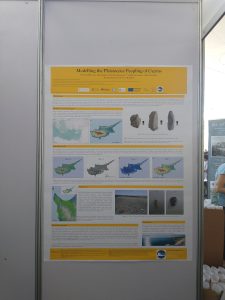
Project MIGRATE was extremely honoured and excited to participate in the World Archaeological Congress (WAC-9) that took place between 3–8 July 2022, in Prague, Czech Republic. A poster was prepared and presented during the conference proceedings both via an electronic platform open to participants and via a speed presentation session. The poster can be accessed here: POSTER_WAC_FINALorange
Last Updated on March 8, 2024