
Design Approach
The prototype system of the adaptive canopy structure with thin-film photovoltaics is envisaged to upgrade the public space through the production of solar energy and the provision of shading underneath. The latter is associated to the reduction of direct exposure to the sun within the public space and the provision of a more thermally comfortable environment during daytime, especially in the summer period. The thin-film photovoltaics structure unit can be realized in various public spaces. At a preliminary stage, the conceptual development focuses on the generative design and preliminary load-deformation analysis of the system. These tasks have been conducted through an interdisciplinary interactive process that involves generative design, numerical analysis and automated fabrication, as follows:
- The development of the geometrical parametric control algorithm in Grasshopper plug-in for Rhinoceros software (Grasshopper, n.d.; Rhino 3D, n.d.), that enables definition of the geometrical characteristics of the structure and its motion analysis.
- The numerical analysis of the structures load-deformation behavior under self-weight and wind loads, using the Geometry Gym plug-in for Grasshopper software (Geometry Gym, n.d.) and the Finite-Element Analysis, FEA, SAP2000 software (SAP2000, n.d.), Fig. 1.
- The automated fabrication of the structural components and connections involves cutting of the metal and aluminum parts based on geometric parameters, 3D printing of the kinematic parts, such as gears and pulleys, 3D printing of small-scale models for the kinematics investigation and the prototype’s representation. In this paper, a 3D printing in scale 1:2 for the prototype representation of the design solutions aims at enhancing interdisciplinary collaboration in future work that involves the kinematics investigation.
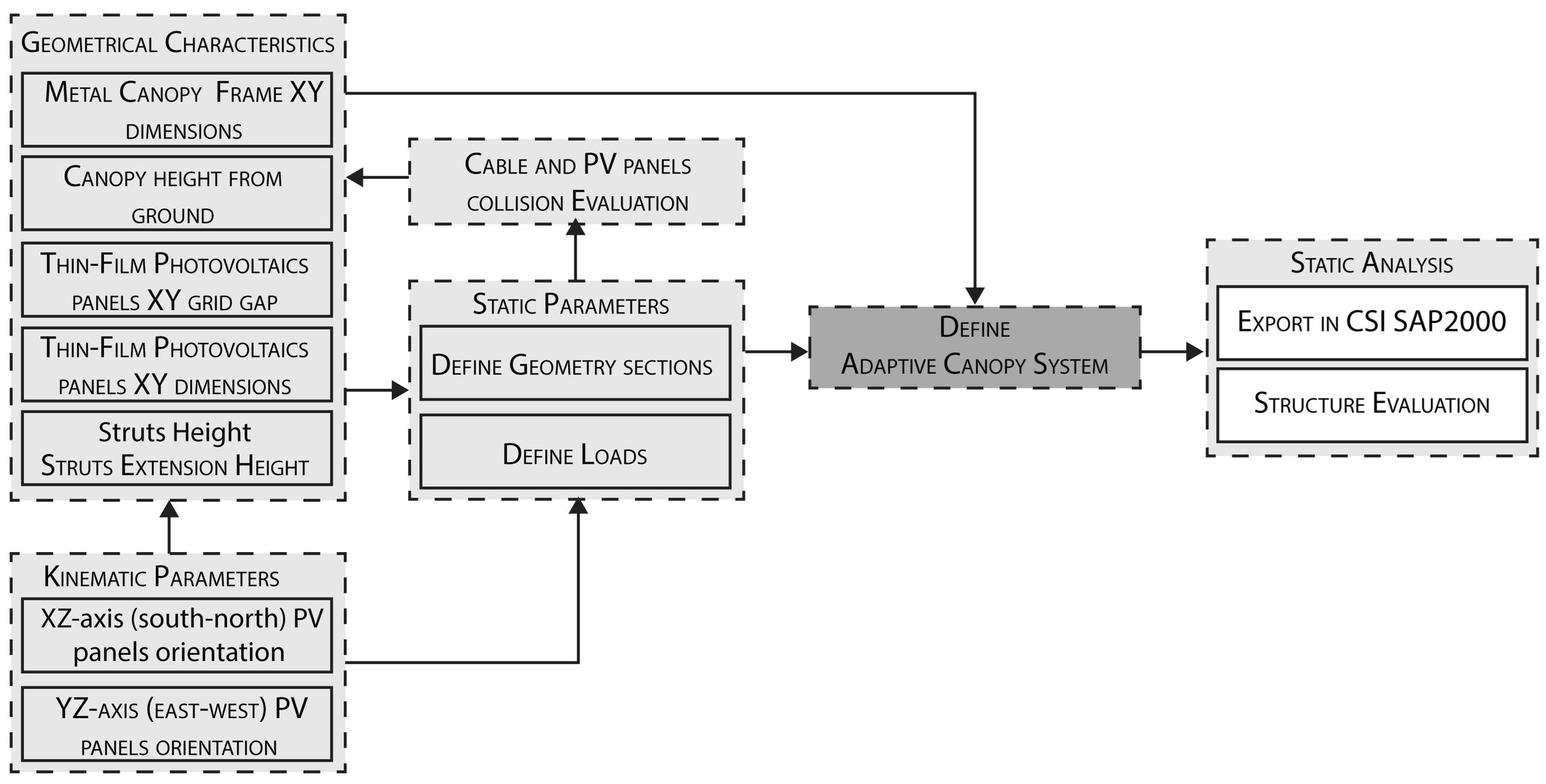
Fig. 1. Flowchart of parametric design algorithm in Grasshopper plug-in for Rhinoceros software for the geometrical characteristics’ definition of the structural unit elements
Adaptive Structure System
The adaptive structure’s primary system comprises a cable net that spans an orthogonal shape aluminum frame, supported by four columns at the corners. The modularity of the system enables generation of multiple possible orthogonal frames in the horizontal plane, covering corresponding large areas of public spaces. The primary system supports a secondary one of aluminum struts that are interconnected through secondary control cables at their upper and lower ends. The upper part of the struts is extended to support the aluminum plates for the thin-film photovoltaics to be attached.
The struts angle can be adjusted on the two vertical planes XZ and YZ, which are controlled by the start and end segment on the secondary cables, Fig. 2. Any adjustment of the cables’ length, results in corresponding rotation of the struts and the thin-film photovoltaic modules that are connected at the top. The system’s kinematics allow simultaneous rotations in both axes, so that the thin-film photovoltaic modules correspond to the solar daylight movement. The cable length is adjusted through a pair of pulleys at each end. A single geared motor connected to each aluminum frame section connects the respective pulleys in series though a rotating axis. In this way, each structural unit is operated by only four actuators.
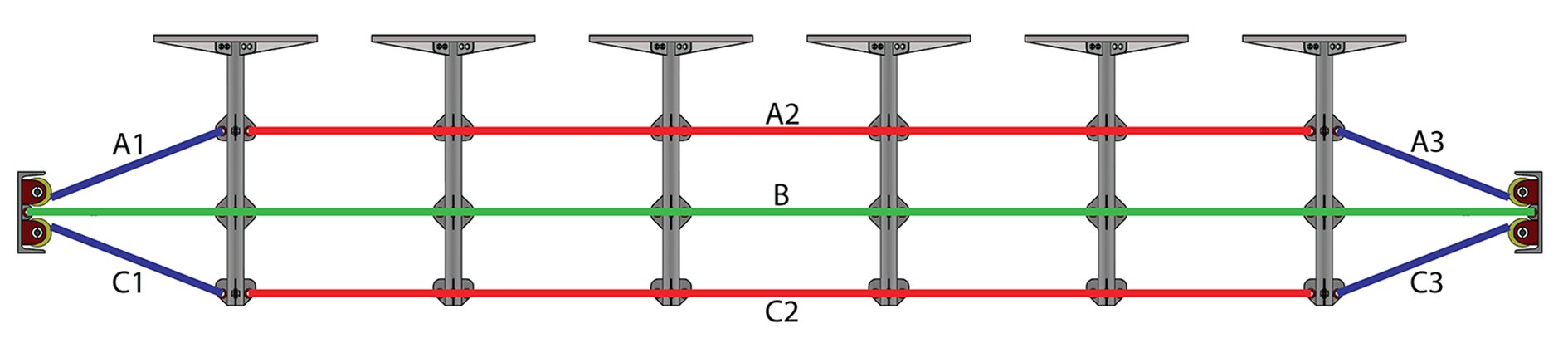
Fig. 2. Structural unit elements in horizontal, initial position of the struts
Structural Analysis
FEA of the system considers the self-weight of the structure and a wind loading of 1 kN/m2 acting on the plates supporting the thin-film photovoltaic modules in various rotational angles. The movement of the system is symmetrical in Y axis, and FEA considers discrete rotations of the struts of 0, 15, 30 and 45 degrees in both axes, X and Y. The 0-degree rotation on both XZ and YZ planes refers to the absolute vertical position of the struts (i.e., absolute horizontal position of the thin-film photovoltaic modules). Movement in both axes XZ and YZ results in 16 cases. Every system case refers to a specific rotation of the struts on the XZ and YZ plane with all connection joints locked. FEA results for the system configuration state corresponding to struts rotational values of 45 degrees in the X-axis and 45 degrees in the Y-axis under self-weight and wind loads are depicted in Fig. 3.
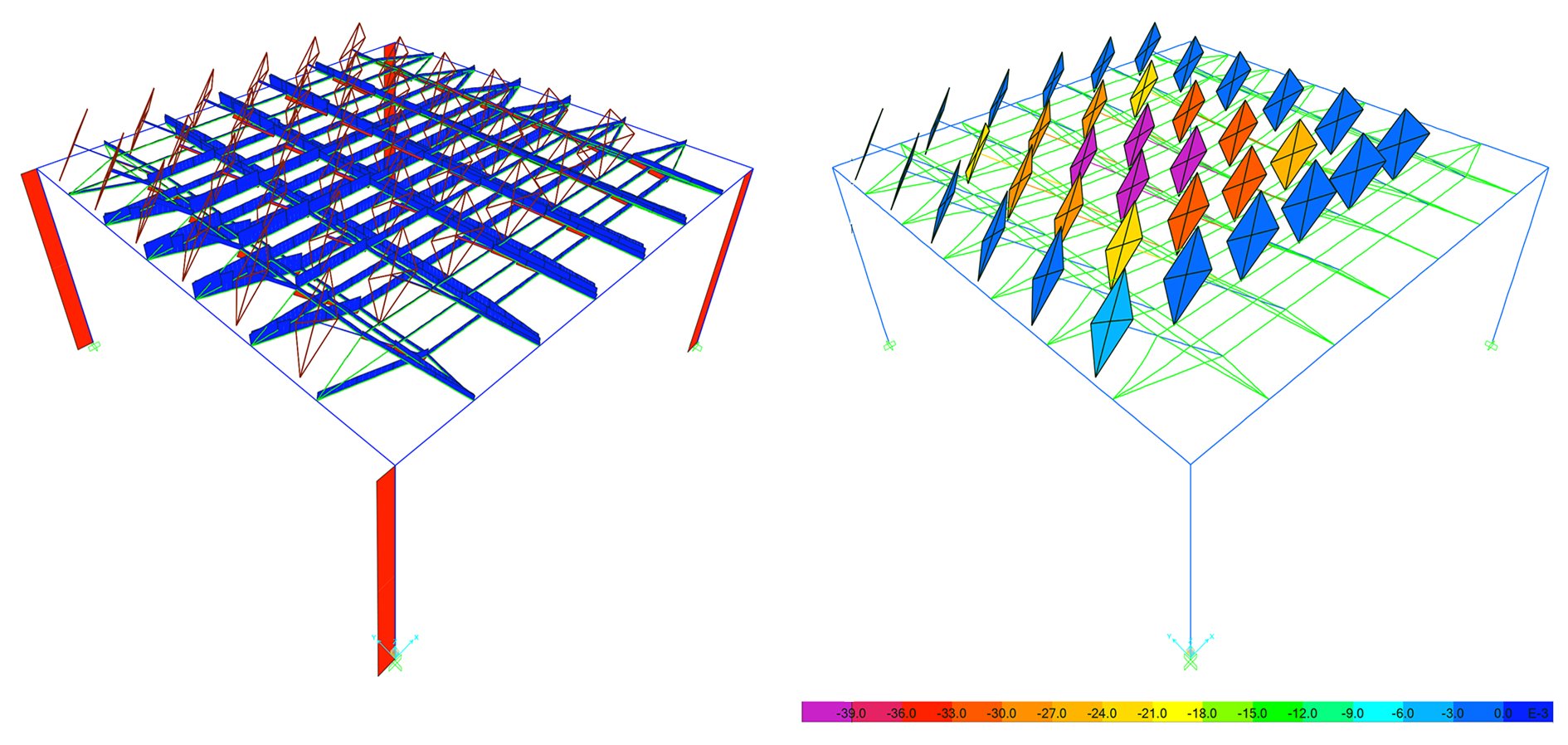
Fig. 3. FEA results for system case 45/45 degrees on the XZ and YZ plane under wind load: Axial force diagram (left) and plates vertical displacements (right)
Photovoltaic Energy Performance
The energy performance of the adaptive, lightweight structure integrated with thin‑film photovoltaic (PV) modules was evaluated under three operating scenarios:
- A fixed orientation was set to the annual optimal tilt angle for maximizing yearly energy yield.
- The PV modules were arranged in a static, horizontal alignment.
- The system was operated dynamically, cycling through 28 discrete orientations that had been optimized for solar irradiance on key dates (March 21, June 21, September 21, December 21 at 12:00 local time).
Each configuration was defined by combined vertical (VR) and horizontal (HR) rotations of supporting struts (0°, 15°, 30°, 45°) about the X‑axis (southward orientation) and Y‑axis (east–west orientation), respectively. The 3D geometries were exported from Rhinoceros software and analyzed using PVGIS, which employs the PVGIS‑SARAH2 solar radiation database provided by CM SAF. Solar irradiance inputs (direct, diffuse, and reflected components) and projected PV output were obtained for the 2020 climatic averages at two representative sites: Nicosia, Cyprus (35.160° N, 33.378° E) and Stockholm, Sweden (59.330° N, 18.071° E). The model assumed copper indium selenide (CIS) thin‑film PV modules with a total installed capacity of 1.783 kWp, and a cumulative system loss of 14 %.
The adaptive system configurations were found to outperform the fixed ones in both Cyprus and Sweden. During optimal seasons, energy output was increased by 18–25 % relative to the fixed orientation, Fig. 4. However, seasonal performance variations were observed across regions: in Cyprus, peak efficiency was recorded in March (spring equinox), with an increase of 32 % over the annual average; in Sweden, maximum output occurred in June (summer solstice), with a 28 % gain. In December, energy production was very low at both sites, especially in Sweden, where output approached zero W/m². Over that month, only marginal improvement (< 5 %) was observed by reorientation compared to the fixed configuration, indicating a limited benefit under conditions of extremely low solar irradiance.
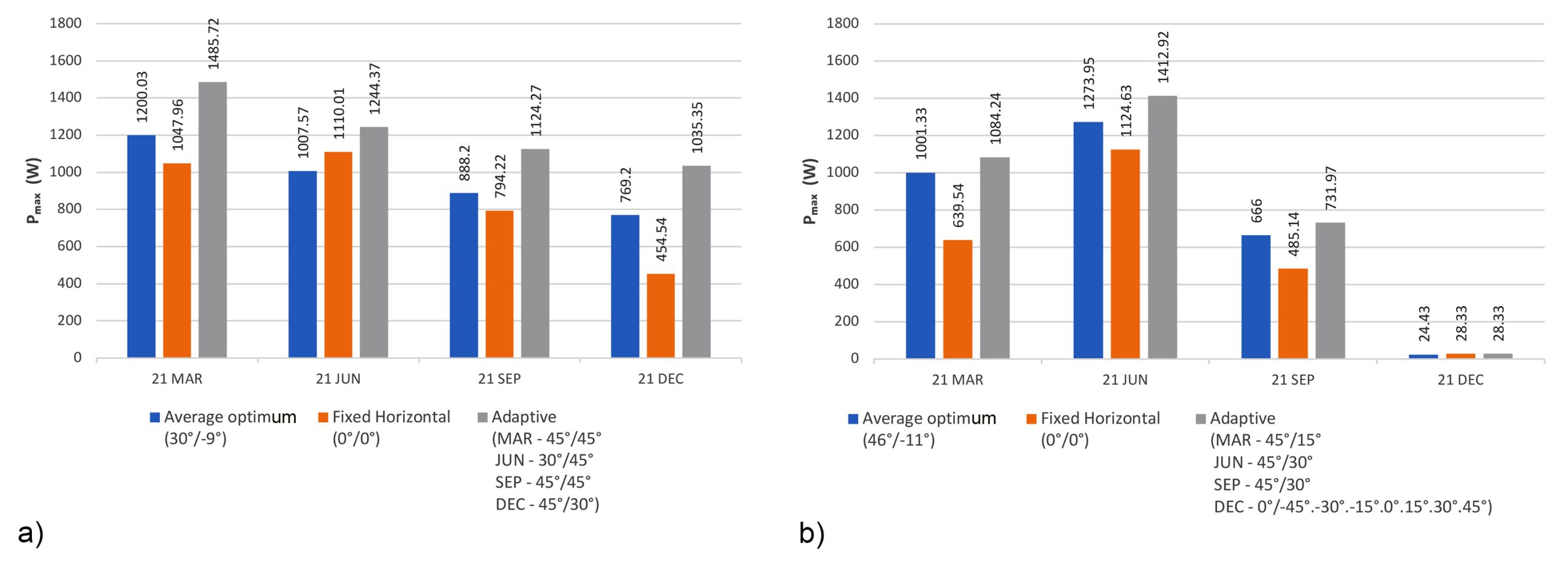
Fig. 4. Maximum PV system power on 21st of March, June, September, and December at 12:00 p.m.: a) Nicosia, Cyprus; b) Stockholm, Sweden.
Prototype Development
The structural and control systems were designed following modular principles to facilitate component interchangeability and simplify assembly procedures. The configuration was optimized to minimize actuation requirements while ensuring full system transformability and achieving reduced self‑weight via optimized material distribution. A 1:5 scale prototype was fabricated, comprising an orthogonal frame, to which the cable net was anchored, Fig. 5. The prototype includes a grid of aluminum struts with PV mounting plates placed at corresponding constant intervals along the secondary and control cables.
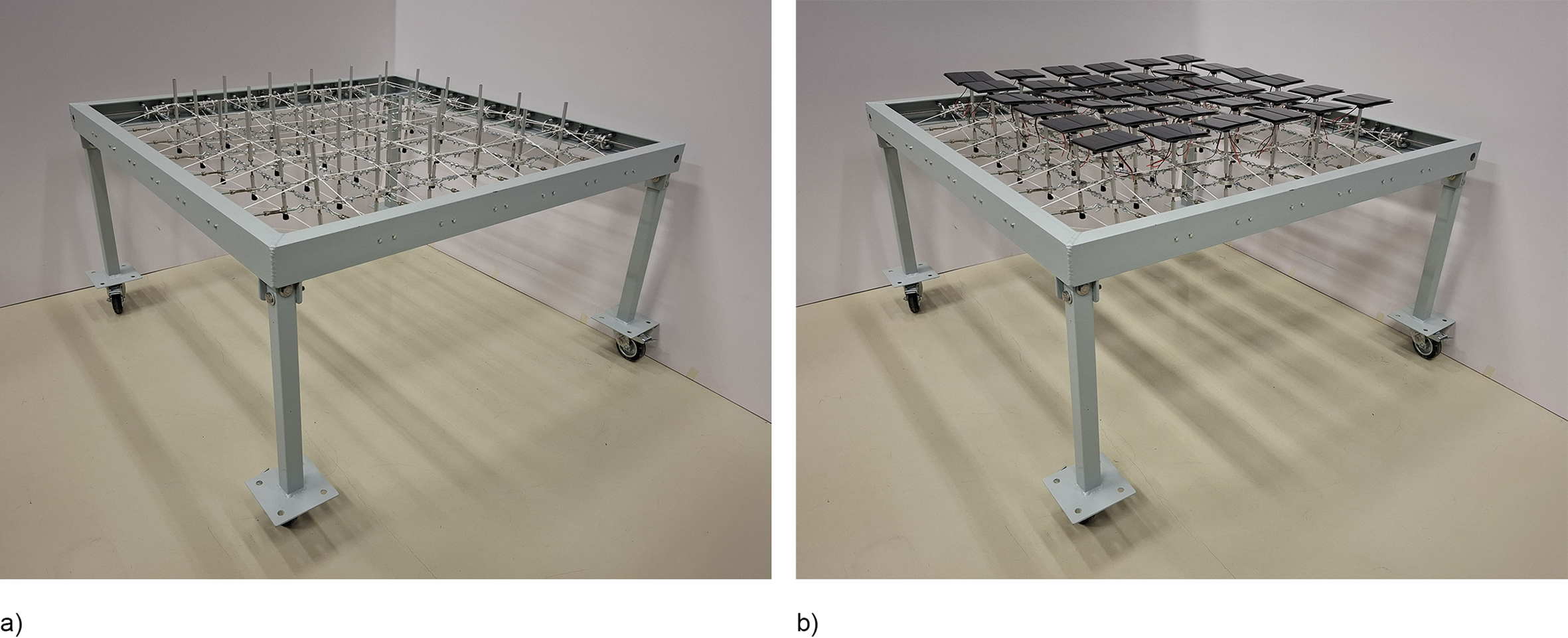
Fig. 5. Small-scale prototype of the adaptive lightweight system: a) System with primary and secondary members; b) System with PV modules installed on the struts.
Publications
- Phocas, M.C., Tryfonos, G., Matheou, M., Christoforou, E.G., Comparative Load-Deformation Analysis of an Adaptive Lightweight Canopy System with Thin-Film Photovoltaics. Rinke, M., Hvejsel, M.F., (eds.), Structures and Architecture. REstructure REmaterialize REthink REuse, Sixth International Conference on Structures & Architecture, ICSA 2025, 08.07-11.07.25, Antwerp, Denmark, Proceedings, Taylor & Francis, London, pp. 1625-1632, July 2025
- Christoforou, E.G., Vourkos, E.G., Dimitriou, P., Agathokleous, R., Müller, A., Phocas, M.C., Prototype of a Cable-Actuated Lightweight Canopy System installed with Thin-Film Photovoltaics. Krommer, M., Schagerl, M., Nader, M., (eds.), 11th ECCOMAS Thematic Conference on Smart Structures and Materials SMART 2025, 01.07-03.07.25, Linz, Austria, Proceedings, Linz, pp. 1-9, July 2025
- Tryfonos, G., Phocas, M.C., Christoforou, E.G., Matheou, M., Generative Design and Fabrication in the Development of an Adaptive Canopy System with Thin-Film Photovoltaics. Kontovourkis, O., Phocas, M.C., Wurzer, G., (eds.), eCAADe 2024, Data-Driven Intelligence, Proceedings of the 42nd eCAADe International Conference 2024, 11.09-13.09.2024, Nicosia, Cyprus, Proceedings, Nicosia, eCAADe, Brussels, Vol. 1, Section: Structures, pp. 439-446, September 2024
Last Updated on October 10, 2025