
Telemachos Kanthos 1910 – 1993
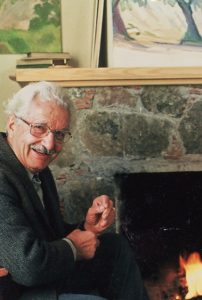 Telemachos Kanthos, the Greek Cypriot painter, engraver, teacher, and stage designer was born in the mountain village Alona in 1910 and died on November 18, 1993 in Nicosia, Cyprus. Between 1929 and 1939 (with an interruption during 1932-34) he studied painting at the Department of Fine Arts of the Athens Polytechnic under Spyros Vikatos, Umbertos Argyros, Dimitrios Biskinis, and graphics with Yiannis Kefallinos. Alongside his fellow students, Y. Moralis, Y. Tsarouchis, N. Engonopoulos, Tassos, G. Demou, D. Daniel, G. Manoussakis a.o., he belongs to the famous “Generation of the thirties”. Yiannis Kefallinos in the graphics as well as the works of Cézanne and other French contemporaries influenced Kanthos’ art far more than his rather conservative teachers of painting.
Already during his studies, the artist worked for the graphic company ELKA in Athens and Corfu and was about to take his final exams in 1939 when the onset of World War II forced him to return to Cyprus. It was only after the war, in 1956, that he was able to take the exams and receive his diploma from the Polytechnic, now “Athens School of Fine Arts”.
Until 1942 Kanthos had to restrain his activities in his native village Alona mostly drawing, painting aquarelles and occasionally illustrating books. Lack of materials as well as poor finances allowed almost no oil paintings during that period of his life. In the following two years he took up an engagement to teach art at the Gymnasium of Famagusta and devoted much time as a stage and costume designer for the newly established theatrical companies of Cyprus ” Lyricon” and ” Neon Lyrikon”.
In 1949 Kanthos spent five Months in Europe, visiting museums and galleries mainly in London but also in Paris. On this journey he spent some time drawing at Heatherley’s School of Art in London. He visited Italy on his way back to Cyprus, where he had been appointed to teach art at the Pancyprian Gymnasium. Later in his life Kanthos often revisited European centres of art and between 1981 and 1993 he spent some time painting and drawing in Vienna, where his daughters pursued musical careers. Major exhibitions of his works took place in Cyprus (Famagusta 1934, Nicosia, 1940, 1959, 1973, 1979, 1985, 1989), Athens (1972, 1982), Vienna (1991) and (posthumously)London, 1996, Berlin, 2004 and Helsinki 2008. The artist represented Cyprus in many international group exhibitions.
From early on Kanthos’ main interest lay in the human figure and portrait as well as in the landscape. Many of his subjects are taken from rural and village life in Alona, his native place. Harmonization of surfaces and colours and the schematization of forms and backgrounds always went beyond exterior detail to provide a sense of place and inner meaning. His recurring hallmark is a vibrancy and purity of colour. Believing that an artist is free to move back and forward in time as he wishes, Kanthos consciously selected impressionism as his starting point. As he stated later, impressionistic painting was an experience he did not wish to miss but he eventually developed his personal way towards abstraction. His understanding for the atmosphere and feeling that underlies external appearance of things conveys enormous immediacy and expressive power to his works.
The situation after the war in 1974 inspired some monumental oil paintings. In these works his innate lyricism so characteristic of the rest of his work gave way to dramatic expression. In the same period Kanthos created also a series of twelve most powerful engravings, “The Hard Years”. Works of maturity vigorous and dramatic, with considerable expressive force they tend to be frugally composed, contain powerful symbolic content and they are particularly striking for their expressiveness and intensity of inner mood and emotion. In 1984 the series was awarded a prize at the XV biennale of Alexandria.
In 1979 the Academy of Athens honoured Kanthos with the Alexandros Diomedis prize.
Last Updated on April 2, 2024


