
Abstract
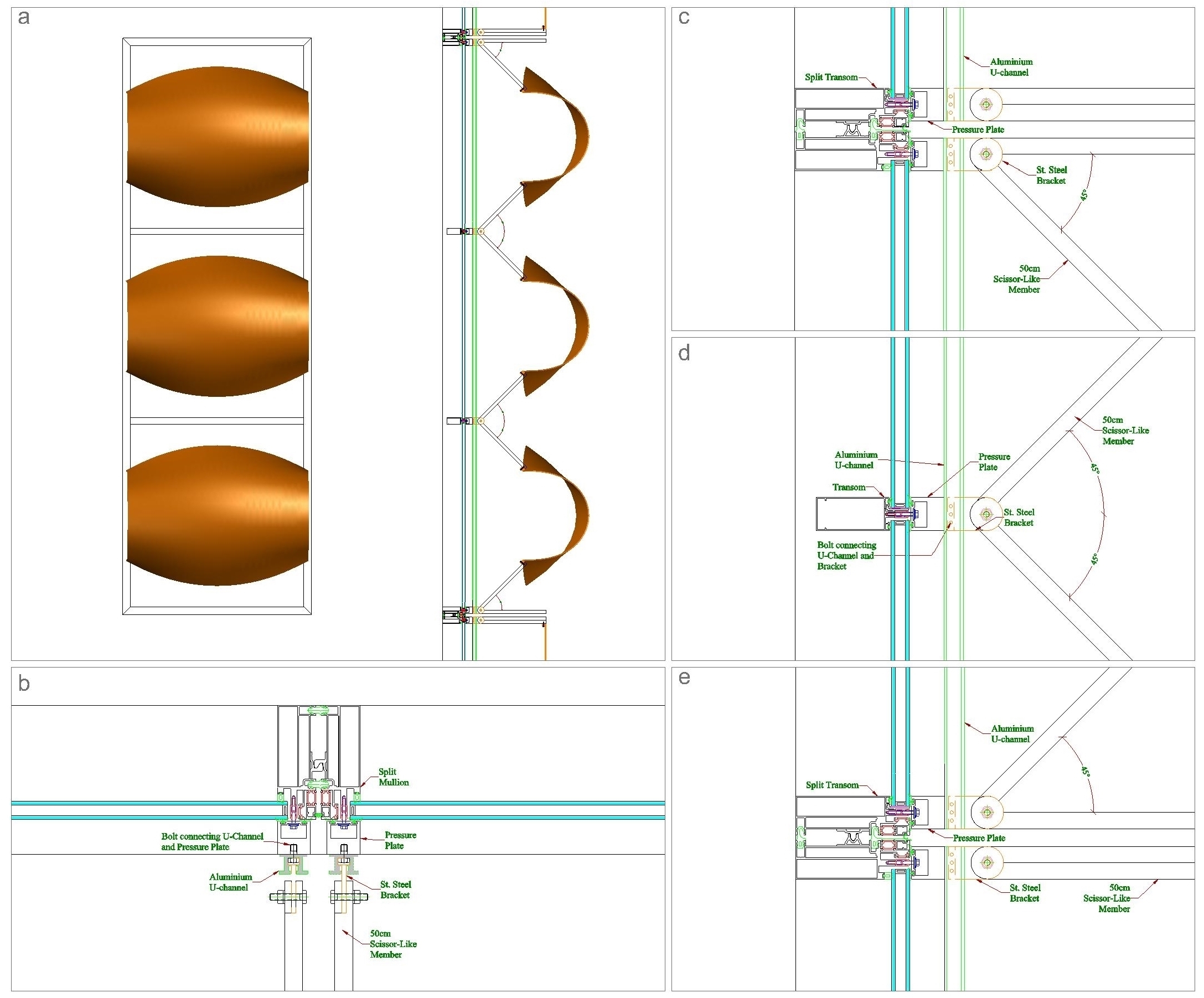
The research delves into the realm of adaptive building facades, which are technologically advanced systems that can respond dynamically to environmental conditions by utilising innovative materials, control actuators, and kinetic features. In recent years, bending-active plates have emerged as a revolutionary structural system that can respond to external stimuli by adapting their forms, offering possibilities in lightweight, efficient, and adaptable structures. Next to adaptive facades, curtain walling systems play a pivotal role in contemporary architecture, which impacts design flexibility, cost, and installation time. Unitized curtain walls combined with sun-shading adaptive systems have become a prevalent choice for high-rise building façades. The research focuses on the design of a novel sun-shading facade system utilising bending-active plates of glass-fibre reinforced polymer (GFRP) strategically arranged and integrated into unitized curtain wall panels. These plates are supported by scissor-like elements located at the four corners of each plate, which are paired and equipped with rotating actuators to modify their opening angles. This modification induces elastic deformations on the bending-active plates, altering their shapes and offering adaptable sun-protection solutions. The analysis procedure primarily investigates the bending-active plate's deformability by simulating the scissor-like elements' motion through specific combinations of actuating angles. A parametric design approach explores different curvatures of the deformed elastic plate. Various symmetric curvatures of the plate are achieved by actuating the scissor-like elements at specific opening angle values. In addition, a numerical analysis is conducted through progressive form-finding and load-deformation Finite Element Analysis (FEA) with a particular focus on the geometrical aspects of the active formation process. Furthermore, the analysis considers the plate's self-weight and a uniformly distributed external wind load. Finite element analysis examines deflection, stress distribution, and strain levels. In addition, the research explores different plate thicknesses, with the most favourable plate thickness investigated further for alternative perforation patterns and percentages. The form-finding and load-deformation behaviour analysis of the bending-active plate shed light on the structural integrity and functionality of the sun-shading system. The research aims to provide valuable insights into designing and optimising GFRP sun-shading devices in architectural applications.
Publications
- Sergidis, C., Phocas, M.C., Numerical Analysis of a Bending-Active Plate for a Sun-Shading Façade System. Choi, C.-K., (ed.), The 2023 Joint World Congress on Advances in Structural Engineering & Mechanics, ASEM23, and Advances in Nano, Bio, Robotics and Energy, ANBRE23, 16.08-18.08.23, Seoul, Korea, Proceedings, Seoul, pp. 1-10, August 2023
- Sergidis, C., Phocas, M.C., Adaptive Sun-Shading System Integrated in Unitized Curtain Wall. Proceedings of the 17th Advanced Building Skins Conference & Expo, 20.10-21.10.22, Bern, Switzerland, Proceedings, Bern, Section A6: Responsive and Adaptive Building Skins, pp. 179-187, October 2022
Last Updated on March 26, 2026