
Abstract
Nostalgia and the city are terms characterized by an ambiguous yet intimate relationship that is well defined by researchers from different academic fields such as anthropology (Olivia Ange, 2015) cultural geographies (Legg 2004) and social sciences (Boonnett, 2016; Boym 2001). Defined as a backward glance to a place and time that no longer exists or has never existed, nostalgia implies an inseparable interconnection with the concepts of space and time (Boym, 2001). As a spatio-temporal practice, nostalgia plays a key role in the way we perceive, envision and built our environment through its involvement in representations of the past, historical narratives, notions of identity, as well as the way our everyday perception operates.
Especially today, at a time where cities are marked by conditions of rapid change and extreme mobility of people and goods, feelings of disorientation, displacement and alienation hold a central position. In the case of Nicosia, the violent enforcement in 1974 of a de facto boundary known as the Green Line, becomes an important physical manifestation of a turbulent era between Turkish and Greek Cypriot communities, a spatial symbol of an unresolved socio-political conflict. As a consequence, 200,000 Greek-Cypriots were forced to leave the north part controlled by the Turkish army while 65,000 Turkish Cypriots moved to the north side (Demetriou, 2012). The imposition of the Green Line is recognized by many scholars as an event, which has triggered nostalgia (Papadakis 2006; Bryant 2008). In fact, the violent disruption of space and time caused by the enforcement of the boundary has had a real emotional effect on people and has thereby left an indelible mark on their perspective and consciousness.
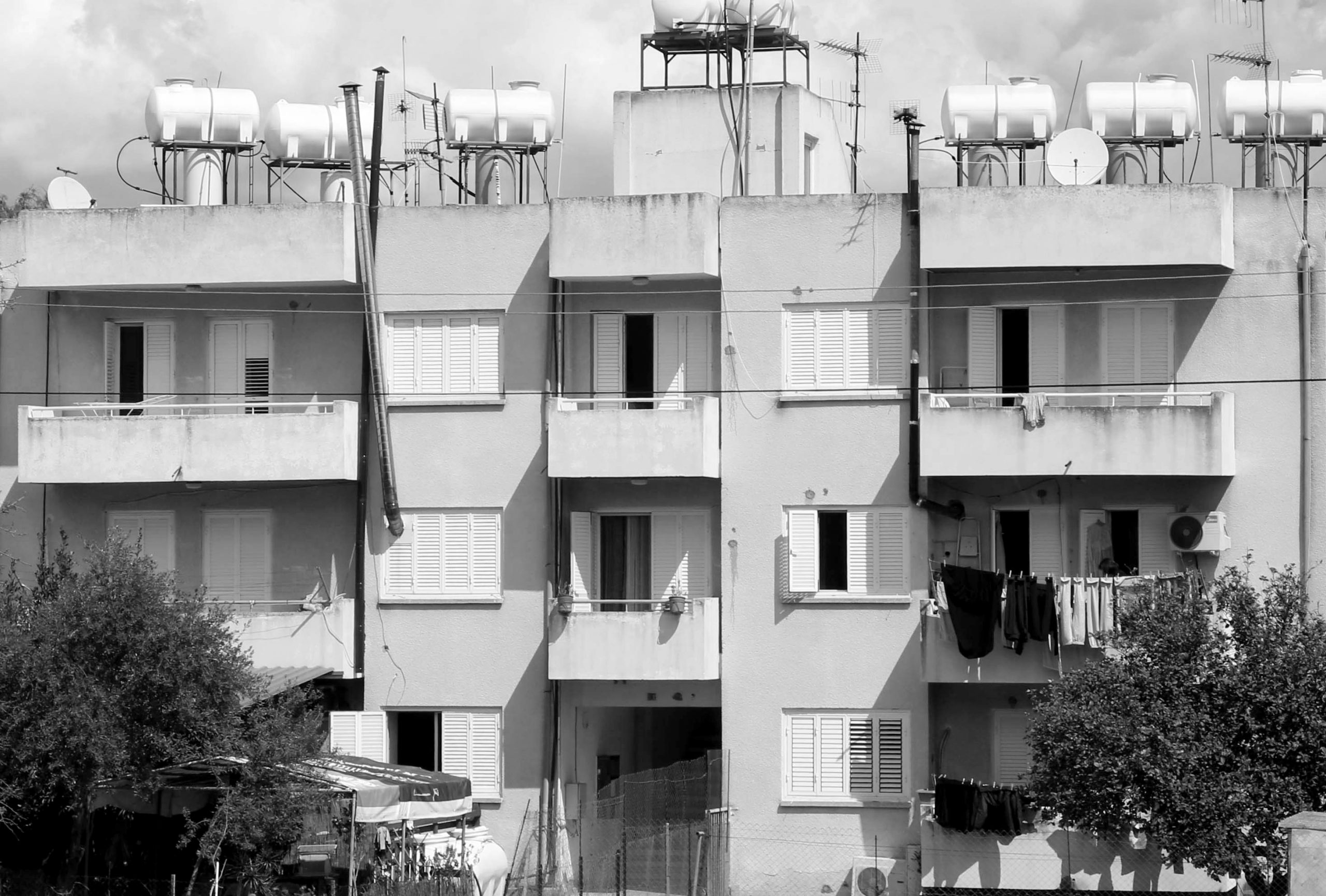
This study is grounded in Nicosia and especially in the context of forced displacement. A refugee housing estate for the internally displaced Greek Cypriots of the 1974 war is here explored as a unique place of nostalgia. By applying a multi-disciplinary approach, this research aims at illustrating the creative impact and the varied levels of nostalgia that can potentially be found in home-making processes. What emerges is a particular mode of architecture, call it architecture of nostalgia, that offers a new lens for thinking the built environment and its home-making processes: reconstructions, representations and reimaginations.
This research aims to encourage wider discussion on the critical and dynamic nature of nostalgia in the contemporary built environment. At the heart of this study lies the argument that nostalgia in the city of Nicosia and especially in the context of displacement is a creative spatial practice, and a vital component intrinsically related to the shaping of a vibrant built environment. Although focused on the specific context of Nicosia, the study is not solely intended to be limited on the local issue, but rather it seeks to offer original insights and alternative means for exploring the contemporary city and its space-making processes: re-presentations, re-constructions, re-imaginations. Therefore, the intention of this study is to provide to both theorists and practitioners an effective tool for coping with the complexities of the constantly changing urban environment and providing resources for articulating future possibilities.
References
- Boym, S., 2001. The Future of Nostalgia. New York: City Press.
- Bryant, R., 2008. Writing the catastrophe: nostalgia and its histories in Cyprus. Journal of Modern Greek Studies, 26(2), pp. 399-422.
- Demetriou, O., 2012. Life Stories: Greek Cypriot Community, Oslo: Peace Research Institute Oslo.
- Legg, S., 2004. Memory and nostalgia. Cultural Geographies, 11, pp. 99–107.
- Olivia Ange, D. B., 2015. Anthropology and Nostalgia. New York: Berghahn Books.
- Papadakis, Y., 2006. Nicosia after 1960: A River, A Bridge and a Dead Zone. GMJ: Mediterranean Edition, pp. 1-16.
Publications
- Chatzichristou, C., Gounaridis, K. & Miltiadou, K., 2022. Memory and Nostalgia as Ariadne’s thread: the case of Ledra Street in the divided city of Nicosia. Lisbon, Notre Dame University-Louaize, pp. 71-73.
- Chatzichristou, C. & Miltiadou, K., 2020. And with a pinch of nostalgia: Traces of the past in Nicosia’s present and future. Valencia, EAAE-ARCC International Conference & 2nd VIBRArch, pp. 69-81.
- Chatzichristou, C. & Miltiadou, K., 2021. The ubiquitous and doubly virtual nature of nostalgia: Visions for the Nicosia Buffer Ζone. Nottingham, IASTE Working Paper Series, pp. 43-57.
- Chatzichristou, C. & Miltiadou, K., 2023. Different Kinds of Nostalgia and their Products: The case of the Divided City of Nicosia. Prague, AMPS Proceedings Journal Series, pp. 592-601.
- Chatzichristou, C. & Miltiadou, K., 2024. The Telling of Histories: The Utterings of a Monument. Doublin, AIARG - 2024 Conference Organising Committee (forthcoming).
Last Updated on March 26, 2026