



Professor Panos Papanastasiou on Alpha Cyprus: Discussion on Cyprus’ Electricity Interconnection
December 11, 2025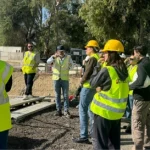
Strengthening the Link Between University, Job Market and Industry: Students Visit Cyfield Group Construction Projects
December 11, 2025
The Dean of the Faculty of Engineering, Marina Neophytou, Professor in the Department of Civil and Environmental Engineering and an expert in environmental issues, in an intervention on 18 December 2025 on Politis Radio’s Programme “Morning Review”, spoke about climate change and its impacts at both local and global levels.
Professor Neophytou presented well-documented views on the phenomenon of climate change, based on findings from computational studies conducted at the Faculty of Engineering. As she noted, the rise in global temperature is not merely a theoretical concept, but a phenomenon that can be measured in practice, both quantitatively and in terms of the local factors that play a decisive role in intensifying its impacts.
The discussion examined the multiple consequences of climate change and how these translate into everyday local experience, with particular emphasis on the role of human intervention. Responding to a question by journalist Katerina Eliadi on what can be done to slow the rise in temperatures, she stressed that a significant part of the phenomena we experience is not due solely to the natural dimension of climate change, but also to the way our cities have been designed and developed.
“The way we have concreted over urban space, the removal of greenery, and the materials we use in construction intensify the impacts,” she noted characteristically, emphasizing that more trees and less concrete would lead to reduced retention of stormwater and, consequently, to fewer flooding events.
Ms Neophytou underlined that it is not the extreme weather event itself that causes destruction, but primarily the way it is managed at the local level. She referred to shortcomings and gaps in the implementation and monitoring of legislation, pointing out that the law and climate research must go hand in hand.
As she stated, from this point onward it is possible to prevent further impacts, as these are primarily issues of governance and, by extension, issues of social and environmental justice.
Responding to the question of whether a small country such as Cyprus affects the global climate, Professor Neophytou clarified that the local experience of climate does not fully coincide with the global phenomenon.
The intervention highlighted the pivotal role of the Faculty of Engineering’s scientific research in public discourse and in the formulation of evidence-based policies to address the climate crisis.


