
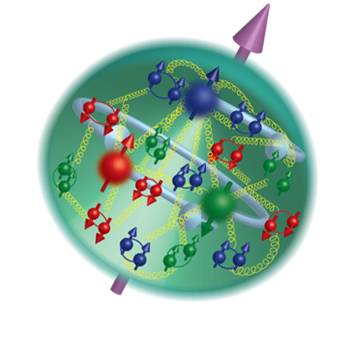
The key objective of the project Three-dimensional imaging of the nucleon using lattice QCD (IMAGE-N) is to reveal the three-dimensional (3D) structure of protons and neutrons, collectively called nucleons, using recent theoretical breakthroughs within lattice Quantum Chromodynamic(QCD). Protons make over 99% of the visible matter in the Universe, and understanding how their properties arise from the fundamental theory of the strong interactions, QCD, constitutes a central goal of fundamental physics and a milestone of Nuclear Physics. A 3D imaging study of the nucleon is motivated by the unprecedented experimental precision afforded by current facilities and, most importantly, by the physics capabilities of the Electron Ion Collider (EIC) under construction at Brookhaven National Lab (BNL).
Principal Investigator: Assoc. Prof. Nicolaos Toumbas
Scientific leader: Prof. Emer. Constantia Alexandrou
Objectives
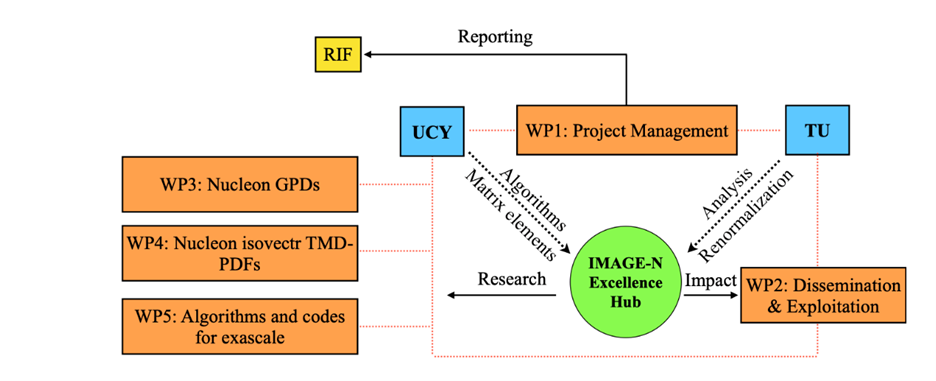
• Objective 1: Direct evaluation of generalized parton distributions (GDPs) for the nucleon (WP3), the forward limit of which yield the better measured parton distribution functions (PDFs). These are target quantities of several experiments and specifically of the EIC using several physical processes, such as Deeply Virtual Compton Scattering (DVCS) and Deeply Virtual Meson Production. Their lowest moments are related to the nucleon elastic form factors. We will employ the quasi-GPDs approach proposed by X. Ji. It is based on considering matrix elements probing purely spatial correlations that are, thus, calculable in Euclidean lattice QCD. One, however, must boost the nucleon to large momentum so a matching procedure is applicable. We will use a recently developed asymmetric frame allowing to extract efficiently several values of the momentum transfer. The method has been tested successfully and further developed by our group. However, progress is still required to reach the required accuracy in order to provide conclusive results. In this project we plan to make significant progress by computing GPDs, including for non-zero skewness, using ensembles generated with physical values of the light quark masses and take the continuum limit directly at the physical mass point.
• Objective 2: Transverse momentum distributions (TMDs) probe the 3D structure of the nucleon in transverse momentum space (WP4). These quantities are more involved since the non-local operator, instead of a straight Wilson line, involves an asymmetric staple. We have done a first study with promising results using an ensemble of gauge configurations simulated with larger than physical pion mass. In this project we will compute the TMDs using an ensemble simulated with physical pion mass. This would require larger resources and a careful study of the renromalization procedure.
• Objective 3: Renormalisation of non-local operators is much more involved than local or semi-local operators from which moments of GPDs can be extracted. For TMDs, the renormalisation is even more involved. In both WP3 and WP4, we will investigate the renormalization of these operators including gluonic ones that exhibit mixing.
• Objective 4: Exascale systems are now a reality in Europe. To optimally use these computers, it will require the development of algorithms and codes (WP5). Such developments are critical in order to gain access to leadership computers such as those provided by EuroHPC Joint Undertaking (JU) that are necessary for competitive research in this field. Our group has years of experience in successfully accessing resources on the biggest systems in the world, such as the pre-exascale machines LUMI in Finland and LEORNARDO in Italy. IMAGE-N will leverage Cyprus membership to the EuroHPC Joint Undertaking (JU) to access exascale systems, such as JUPITER, within a very competitive review process for access.
Milestones
- MS1: First access proposal for computer time approved (M12)
- MS2: First journal publication (M15)
- MS3: First results analysed on the gluon GPD using the cB64 (M18).
Structure of project
Postdoctoral researchers funded by the project
 Antonio Evangelista, PhD 2025, Rome Tor Vergata, Italy
 Srijit Paul, PhD 2019, The Cyprus Institute, Cyprus
 Gregoris Spanoudes, PhD 2019, University of Cyprus
Project Budget: 199,920 €
Start date: 1 May 2025
End date: 30 April 2027
Funding Acknowledgement
The project EXCELLENCE/0524/0459 has received funding from the European Regional Development Fund and the Republic of Cyprus through the Research and Innovation Foundation.

Social Media Presence
This project has also been featured on the Department’s Facebook page.
Last Updated on 20 Μαΐου, 2026

