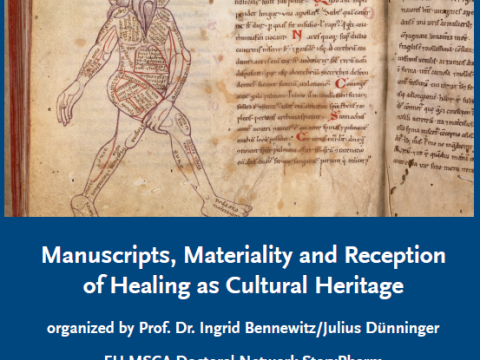
How to Become a Sciencepreneur: StoryPharm Webinar Training in Entrepreneurship
April 9, 2026
BaGraMS “Work in Progress” Day Showcases Interdisciplinary Medieval Research at the University of Bamberg
May 12, 2026Anna Komnene’s Alexiad (12th-century manuscript). Biblioteca Medicea Laurenziana, Florence. View source

Anna Komnene’s Alexiad (12th-century manuscript). Biblioteca Medicea Laurenziana, Florence.
View source
The Authorial Voice in the Middle and Late Byzantine Literature: Narrating Disease, Pain, and Suffering
StoryPharm Blog 9 (April 2026)
Eleni Voutsa
StoryPharm Doctoral Fellow, University of Cyprus
From the fourth century onward, the figure of the author in Byzantium was deeply intertwined with philosophical and rhetorical ideals. To be called a philosopher represented the highest intellectual distinction, while rhetorical mastery remained an enduring hallmark of Byzantine literary culture. Alongside these ideals, the body of rhetorical theory developed by Byzantine scholars, building on the traditions of Plato, Aristotle, and the later Neoplatonic and Second Sophistic Schools, was equally important, providing a systematic framework for questions of authorship and literary expression. A significant development is evident in the eleventh century, when a more self-conscious effort emerges to present authors as heirs to the Empire’s classical past and Christian tradition. By this time, authors increasingly drew on this prestigious intellectual heritage, combining philosophical learning with theological insight to assert their authority and shape their intellectual identity (Papaioannou 2014: 20; 2013: 45–46, 51–53).
Yet this authority did not always imply creative independence. More generally, the Byzantine author was not understood as a fully autonomous creator, particularly in the case of those without aristocratic status, whose works often depended on established traditions and systems of patronage. At the same time, this lack of autonomy was not only social. Within a culture profoundly shaped by Christianity, the identification of Christ as Logos endowed language itself with sacred power, and the ideal Byzantine author emerged as a privileged conduit of divine wisdom, a humble, yet authoritative, intermediary between the heavenly and the human word (Papaioannou 2013: 69–74).
This ideal found its most concentrated expression in monastic literary culture, where texts circulate without a named writer, while others survive under multiple attributions, reflecting the fluid nature of authorship in Byzantium. In monastic contexts specifically, writing was conceived as an act of piety rather than self-expression. The anonymity of the monk-author signified humility, aligning with the Christian rejection of personal glory and ambition. Yet this so-called ‘poetics of anonymity’ did not necessarily entail the absence of self-awareness (Pizzone 2014: 226–227). Many monastic texts reveal autobiographical details, first-person reflections, or collective voices that subtly affirm the writer’s presence within a framework of humility. Byzantine authors appear ‘far from dead’ (Mullett 2014: 175), often fully conscious about their role, yet chose to efface their individuality for theological and ethical reasons. Claiming explicit authorship could entail spiritual risk, as it implies accountability and self-promotion. Thus, anonymity became both a shield and a statement: a rhetorical and moral stance that balanced devotion with literary agency, allowing the author to speak while appearing silent.
While earlier Byzantine authors often cultivated an ideal of anonymity and humility, this stance was not uniform across all periods. By the eleventh and twelfth centuries, a stronger sense of authorial presence became increasingly visible across Byzantine literature. Authors, such as Michael Psellos (1018–1078) and Anna Komnene (1083–1153), display a marked self-referentiality and, at times, even overt self-promotion. Their works thus demonstrate that the author could become a visible participant in the narrative rather than an invisible transmitter of information.
Having outlined the broader framework of Byzantine authorship – ranging from anonymous humility to assertive self-presentation – we may now turn to how these notions of authorial presence take shape in specific Byzantine texts from different literary genres (e.g. historiography, medical treatises, and letters), with particular attention to cases of pathography (from the Greek πάθος + γράφω, ‘to write about one’s sufferings’) and autopathography (αὐτός + πάθος + γράφω, ‘to write about one’s own suffering’).
In his Chronographia, for example, Michael Psellos, a polymath scholar and court intellectual (1018–1078), provides an account about the disease of Emperor Romanos, a case of pathography, where bodily symptoms are combined with moral and psychological interpretation:
An illness of all unusual and painful character befell Romanos. Actually, the whole of his body became festering and corrupted inside. At any rate, from then onwards, he lost most of his appetite and sleep, poised his eyelids […]. All the ill-humours fell upon him together – harshness of character, peevishness of spirit, anger and wrath, and shouting, things unknown to him before. (Psellos, Chronographia, trans. Sewter 1953: 24).
In this passage, the author functions as both a historiographer and an interpreter of Romanos’ suffering. Psellos suggests that spiritual-emotional disintegration as well as inner imbalance often arise because of bodily afflictions. His own presence and observation are evident since the very beginning of the chapter on Romanos: ‘As for Romanos, I have observed him and once addressed him personally; hence, regarding those matters I spoke based on information from others, but this one I am recording myself, having learned it not from others’ (emphasis added). Here, he emphasizes that while he reports some matters based on others’ accounts, his writing on Romanos stems from his own experience. Later, when describing the emperor’s illness, he notes ‘I have often observed’ (emphasis added), signaling repeated self-observation, thereby lending authority and persuasive weight to his authorial words – a strategy of self-displaying, frequently employed in Psellos’ writings.
Later again, when describing the illness of Emperor Isaac Komnenos, Psellos places strong emphasis on his own presence and active participation. As an eyewitness to Isaac’s suffering, he assumes a quasi-medical role, taking the emperor’s pulse and even attempting a diagnosis of arrhythmia. At this point, the narrator positions himself simultaneously as observer, participant, and commentator. Through this self-insertion, Psellos once again reinforces the credibility and authority of his narrative voice, transforming historical reporting into a self-reflective act of witnessing.
Pathographic elements also appear in John Zacharias Aktouarios’ (c.1275–c.1330) On Urines, a work that contains eleven case histories. As Aktouarios was a practicing physician and writer, the authorial voice here appears somehow detached, even though he is actively engaged with the patients. His narration frequently employs the first person, as ‘I remember having seen’ or ‘I have seen’ (Aktouarios, Urines, 4.9.5 and 6.7.11; my translation; emphasis added). His main goal is to establish medical authority, focusing primarily on the patient’s condition and on prognostic and diagnostic processes. In every case, John formulates his diagnosis through careful observation of urine and, at times, blood, subsequently prescribing treatment and recommending ways for the alleviation of symptoms. While he adopts a professional’s didactic and authoritative tone (often referring to physician-readers), he frequently incorporates the patient’s narrative, lending a communal dimension to the medical account. This demonstrates a transitional mode of authorship, where the writer is more present as an expert rather than a reflective participant (Bouras-Vallianatos 2020: 70–99).
A different configuration of authorial presence emerges in the autopathographic narratives of Ioannes Chortasmenos (1370–1437), a scholar, teacher, and prolific writer. In his letter collection, Chortasmenos includes two Narratives concerning an incidental illness, in which he vividly recounts his own suffering, providing meticulous day-by-day details of his condition and placing himself at the very center of the letter; rather than the authoritative eyewitness stance found in Psellos, the text foregrounds an experiential voice of suffering. Written entirely in the first person, with frequent use of the pronoun ‘I’, the text allows Chortasmenos to assume multiple roles: narrator, observer, and physician, as he simultaneously describes both his symptoms and his efforts to cure himself.
The epistolary writings of Gregorios Antiochos (1160–after 1197/8 AD) demonstrate how genre, personal circumstances, and gendered expectation intersect in shaping illness narration. Afflicted with poor health and chronic illness, he does not attempt to gain masculine capital through the traditional avenues of martial or physical achievements; instead, Antiochos frames his bodily limitations as a means to cultivate scholarly virtue. The genre of his text plays a crucial role: in letters to fellow scholars, he emphasises the body as a vessel for intellectual development, while in religious compositions, he interprets illness in moral and spiritual terms, linking physical suffering to sin, the service of God, and the cultivation of the soul.
In the Alexiad, Anna Komnene, ‘writing like a man – since historiography was traditionally a masculine discourse’, consciously seeks to project a positive and authoritative image of female intellect (Neville 2016: 61). Within a culture that idealised female modesty and seclusion, she had to navigate the tension between gendered expectations and her own intellectual ambitions. As Stavroula Constantinou notes, the Alexiad is ‘the work of a sorrowful woman who shared the education and knowledge of a male intellectual and historian such as Michael Psellos’ and it originated from Anna’s attempt both ‘to come to terms with her grief and to perform the traditionally male task of preserving her father’s deeds from oblivion’ (Constantinou 2019: 291).
By framing her narrative in the language of lament and piety, drawing on the rhetorical and emotional repertoire of ancient heroines and mourning figures – especially those from ancient Greek tragic poetry – she legitimises her authorial voice, while transgressing conventional boundaries of female expression. Her prose, imbued with pathos and emotional intensity, also contains self-referential passages, asserting her elite education and mastery of classical learning, performing a ‘masculine’ emotional restraint when needed, while demonstrating her closeness to the imperial subject matter (Neville 2014: 266–273 and Neville 2016: 61–74).
In the closing section of the Alexiad, a form of pathography recounting the death of Emperor Alexios I Komenos, these gendered and emotional features become especially pronounced. Anna offers a detailed description of her father’s illness and sufferings, frequently employing dramatic remarks: ‘if that was not to be my fate, why did I not throw myself down from some high and lofty place or cast myself into the waves of the sea?’ (Anna Komnene, Alexiad, trans. Dawes 2000: 302) and an emotionally charged language (‘alas’). Her narrative is marked by personal grief and rhetorical intensity, blending historical reporting with deep emotional involvement. Anna’s presence stands at the center of the narrative, particularly in her and her mother’s reaction to the emperor’s death – reactions marked by intense expressions of grief such as wailing, screaming, and changing their garments to mourning colours. At this point, narrator and author converge into a single voice. Anna makes no distinction between her narrative persona and her personal grief, explicitly likening her own misfortune and suffering to that of the tragic ancient figure Niobe.
Having briefly examined some aspects of middle and late Byzantine authorship, particularly within the rhetoric of pain and illness, we can recognise how themes of suffering provided an unexpected site of literary innovation. In some works, the author’s presence merges fully with the narrative; in others, autobiographical insight coexists with rhetorical control, or even the voice remains strategically detached and didactic. These are not merely stylistic choices; the suffering body paradoxically enabled Byzantine authors to claim new forms of presence in their texts. For male writers, like Psellos and Chortasmenos, illness narratives offered opportunities to perform intellectual authority. For Anna Komnene, her father’s suffering and death became the very grounds on which she could transgress conventional boundaries of female authorship, transforming grief into historical witness. Across these variations, Byzantine literary production emerges as a dynamic and evolving organism. Despite formal conventions and certain genre-specific constraints, writers could intervene creatively, adapting, innovating, and expressing themselves in ways that reflected their personal emotions, thoughts, and literary aspirations.
References
Bouras-Vallianatos, P. 2020. Innovation in Byzantine Medicine: The Writings of John Zacharias Aktouarios (c.1275–c.1330). Oxford: Oxford University Press
Constantinou S. (2019). ‘Gendered Emotions and Affective Genders: A Response’, in S. Constantinou and M. Meyer (eds), Emotions and Gender in Byzantine Culture. Cham: Palgraver Macmillan, 283–315.
Mullett, M. 2014. ‘In Search of the Monastic Author: Story-Telling, Anonymity and Innovation in the 12th Century’, in A. Pizzone (ed.) The Author in Middle Byzantine Literature: Modes, Functions, and Identities. Berlin and Boston: De Gruyter, 171–198.
Neville, L. 2014. ‘The Authorial Voice of Anna Komnēnē’, in A. Pizzone (ed.) The Author in Middle Byzantine Literature: Modes, Functions, and Identities. Berlin and Boston: De Gruyter, 263–274.
Neville, L. 2016. Anna Komnene: The Life and Work of a Medieval Historian. Oxford: Oxford University Press
Papaioannou, S. 2013. Michael Psellos: Rhetoric and Authorship in Byzantium. Cambridge: Cambridge University Press
Papaioannou, S. 2014. ‘Voice, Signature, Mask: The Byzantine Author’, in A. Pizzone (ed.) The Author in Middle Byzantine Literature: Modes, Functions, and Identities. Berlin and Boston: De Gruyter, 21–40.
Pizzone, A. 2014. ‘Anonymity, Dispossession and Reappropriation in the Prolog of Nikēphoros Basilakēs’ in A. Pizzone (ed.) The Author in Middle Byzantine Literature: Modes, Functions, and Identities. Berlin and Boston: De Gruyter, 225–244.


StoryPharm has received funding from Horizon Europe Programme for Research and Innovation under the action Horizon MSCA Doctoral Networks, Grant Agreement No. 101169114 and the UK Research and Innovation with Grant Ref: EP/Z534523/1