
Stylianos Alexiou – Lefkios Zafiriou Correspondence, editing – commentary by Afroditi Athanasopoulou, To Rodakio, Athens 2022.
January 23, 2023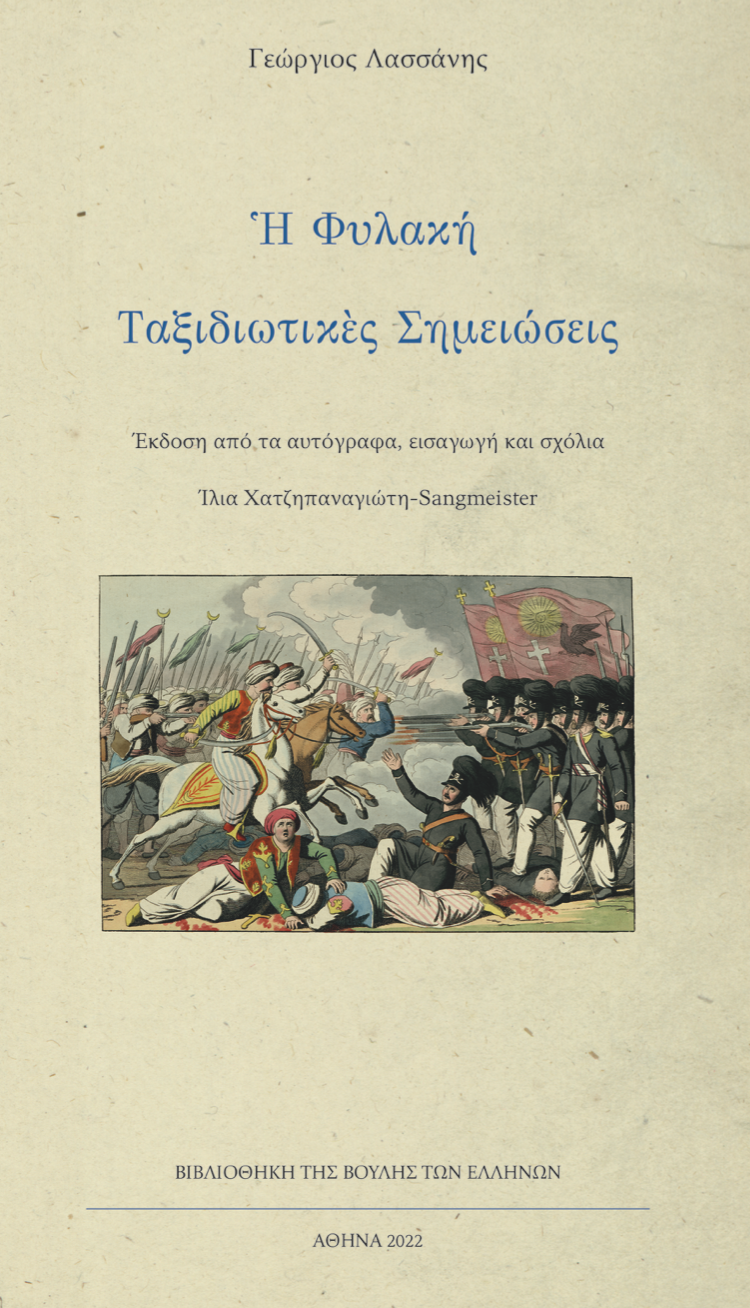
Publication of works by dramatist and poet Georgios Lassanis by Julia Chatzipanagioti
January 30, 2023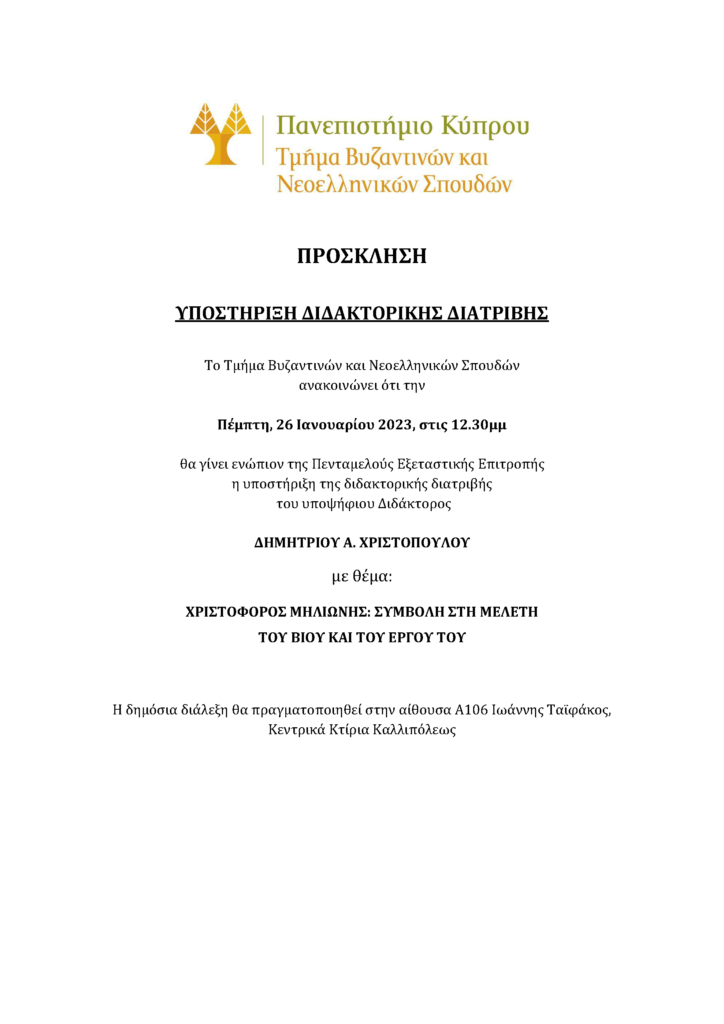

Support of the doctoral thesis of the PhD candidate of the Department of Byzantine and Modern Greek Studies Dimitrios A. Christopoulos on Thursday, January 26, 2023, at 12.30 pm.
Abstract
The present doctoral dissertation explores the multifaceted work of Christoforos Milionis (1932-2017), a key figure in the second generation of post-war Greek novelists, who, because of their age, did not play an active role in the events that marked Greece in the 1940’s, nevertheless, they did not remain indifferent, as they suffered from the effects of the post-civil war climate from the 1950’s onwards. The essential research questions, guiding the course of our research, concern the way in which Milionis contributed to the renewal of the post-war short story, the degree of convergence and divergence from his coeval novelists, the modern reception of his work under the light of Cultural Criticism, as well as how his theoretical and literary work confabulate. The first chapter maps the strong imprints left by the second post-war generation on the history of modern Greek literature. The second chapter encodes the recognizable elements of Milionis's prose which are idiosyncratic to his writing style, namely the experiential writing, the composition of “micro stories”, the associative technique, the leading role of the place of birth in his oeuvre, the special qualities of the author’s narrative voice as well as the rich intertextual nature of his work. The third chapter is dedicated to the critical reception of his prose. As historicity and traumatic memory play a pivotal role in his work, the fourth chapter examines the Greek-Italian War, the German Occupation, the Resistance, the Liberation, the Civil War with its incurable wounds, the post-war years, the seven-year dictatorship in Greece by the colonels, as successive stages of the post-war history of modern Greece and as determining elements of Milionis’s prose work, which inevitably reflects the adventures of his generation. Thus, the dialogue with History is transformed into a dialogue between generations, mentalities and attitudes through associative writing and narration. On this theoretical basis, an attempt is made to highlight the documentary composition of Milionis’s fiction. Moreover, as the renewed ways of reading literary texts spark our interest in older literature, the fifth chapter focuses on The Short-Stories of Trial and illuminates Milionis’s experimentation with the French “new novel/nouveau roman” of Alain Robbe-Grillet. This fact also explains why Milionis’s realism, even in his most pragmatic prose, brings together something indefinable and dreamy, shaping his particular narrative discourse, which is the subject of examination in the seventh chapter of this dissertation. On the other hand, M. Bakhtin’s always relevant ideas on the chronotope, as well as the thoughts of the French philosopher M. Foucault on heterotopia, discussed in the sixth chapter, constitute the basic methodological tools that allow an interesting and renewed approach to Milionis’s work. The eighth chapter examines the representations of the human body and of the Other in his prose work under the light of Cultural Studies. The final two chapters of the dissertation contain the dramaturgic analysis of the only single-act theatrical play by Milionis, entitled At one end of the lake or When the ship sinks, found in his archive (ninth chapter), as well as the study of his wider theoretical and literary work (tenth chapter), in order to demonstrate the way in which Milionis as a novelist is constantly fed by his theoretical concerns and educational sensibilities. The dissertation concludes with the Final Conclusions and the Appendices.