

Quality Teaching Award 2026 to Assistant Professor Nicolas Hadjipantelis
March 23, 2026
Honorary Doctor and Professor Extraordinarius: Dual International Recognition for Professor Despo Fatta-Kassinos
March 23, 2026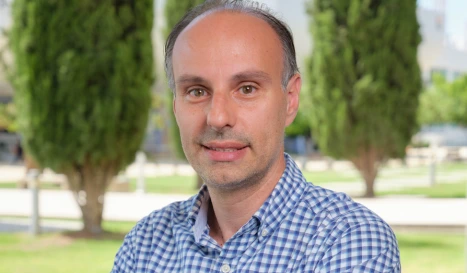
As of 1 January 2026, the University of Cyprus leads the ERC Proof of Concept (PoC) project QUARTO (Quantum Annealing for Fluid Antenna MIMO Systems), a pioneering research initiative funded by the European Union under the European Research Council (ERC) Proof of Concept grant scheme. The funding was secured by Ioannis Krikidis, Professor in the Department of Electrical and Computer Engineering of the Faculty of Engineering and Director of the IRIDA Telecommunications and Networks Laboratory at the University of Cyprus.
Building on the theoretical foundations developed under the ERC Consolidator Grant APOLLO, the QUARTO project extends and experimentally validates the proposed mathematical models for large-scale communication technology applications, while simultaneously exploring technological and commercial pathways for their exploitation.
Key elements of the project
The rapid growth in performance demands for future 6G networks, combined with the increasing complexity of dynamic wireless environments, makes the development of communication technologies that are flexible and capable of real-time adaptation imperative.
In this context, Fluid Antenna Systems (FAS) emerge as a highly promising technology, as they enable dynamic changes in the physical position and shape of antennas, allowing active control of the wireless channel and optimization of overall system performance. FAS rely on conductive metallic fluids that move and reconfigure within specially designed structures, offering an unusually high degree of channel control and reconfigurability.
In simple terms, the QUARTO project aims to create “smarter,” more efficient, and more reliable wireless networks capable of meeting the demands of future digital applications.
Determining the optimal antenna configuration, particularly in multiple-input multiple-output (MIMO) architectures, constitutes a complex combinatorial optimization problem belonging to the class of NP-hard problems. The ERC PoC QUARTO project seeks to address this challenge by leveraging quantum computing techniques and quantum annealing, using both real quantum computers and quantum-inspired algorithms that can also be implemented on conventional computing platforms. The core philosophy of QUARTO lies in embedding the optimization problem into the physical dynamics of computational systems that inherently evolve toward the optimal solution, in a manner analogous to quantum annealing.
The project highlights new opportunities for integrating quantum optimization into the architectures of future wireless networks, paving the way for innovative products, improved energy efficiency, and enhanced reliability in wireless communications. As conventional silicon-based architectures approach their physical and technological limits, the adoption of alternative computational paradigms—such as quantum computing - becomes critically important for the advancement of cutting-edge telecommunications technologies.
ERC Proof of Concept
The European Research Council (ERC) has announced the results of the latest Proof of Concept grant round for 2025. In this round, 136 beneficiaries will each receive €150,000, with the aim of supporting the exploration of how their scientific results can progress toward practical application or early-stage commercial use. With these awards, the total number of Proof of Concept grants under the ERC 2025 programme has reached 300, representing a total budget of €45 million. The programme is funded under Horizon Europe, the EU’s framework programme for research and innovation.
As stated by Ekaterina Zaharieva, European Commissioner for Start-ups, Research and Innovation: “Discoveries arising from research funded by the European Research Council are very often more than academic breakthroughs. They form the foundation of future innovation ecosystems across Europe, inspiring new technologies, businesses, and societal solutions. I am pleased that the EU is funding a record number of Proof of Concept grants this year and congratulate all the beneficiaries on their success.”