
AGIOS SPYRIDON, a 24-meter-long vessel, was one of the last wooden fishing trawlers of Cyprus. It was built in Crete in 1950 and belonged to the type of Karavoskaro, with an elliptical stern. It was registered in Cyprus in 1954 and was used as a trawler until 2004, when it was withdrawn according to EU Fishing Policy.
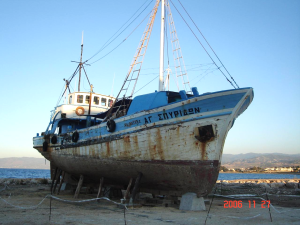
The Agios Spyridon Trawler in 2006, docked at the Latchi Marina (Photo © Kostas Damianides).
The boat was placed on dry land, nearby the marina of Latchi, Polis Chrysochous, to function as a monument of the local maritime heritage. This plan was never materialized, however. The vessel remained out of the sea for 15 years without any maintenance and in 2018, the Municipal Council decided that it should be destroyed for safety and aesthetic reasons.
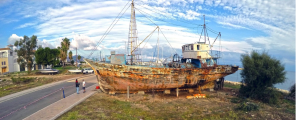
The Agios Spyridon Trawler in 2019, docked at the Latchi Marina (© MARELab).
Despite all efforts to the contrary, its loss was unavoidable.In March 2018, a rescue mission was organised and funded by the University of Cyprus and the Cyprus Institute, during which a 3D model was created. It became clear, however, that more work was necessary. Failing to convince the authorities and potential sponsors to save AGIOS SPYRIDON, controlled destruction and full recording seemed to be the only way to mitigate the consequences of the vessel’s loss. The project commenced in 2019 and was funded by the Honor Frost Foundation, with contributions from the Municipality of Polis Chrysochous and the Cypriot Department of Fisheries and Marine Research. The main objectives of the project were: (i) to preserve the structural, morphological and technological characteristics of the wooden vessel, through digital documentation before and during its controlled dismantling, (ii) to raise awareness about the preservation of nautical heritage, (iii) to preserve as much of its memory as possible, by inviting artists and craftspeople to give a second life to pieces of the hull cut during the controlled destruction, and (iv) to preserve and further study, some of the critical parts of the wooden structure of the boat. Fieldwork was organised into four main phases. Prior to any destruction, an initial recording of the boat was undertaken, which included the digital scanning and production of a 3D model.
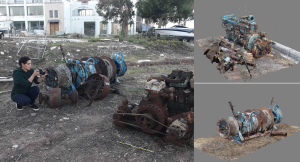
Photogrammetric recording of the winch and the engine (Photo: Georgia Kyriakou; © MARELab).
The second involved the removal of the masts and superstructures, fishing gear, winch, and engine, as well as the deck itself. The third phase concerned the complete documentation of the boat’s interior space. During phase four, the recording of the hull was done using a combination of conventional measurements and the use of 3D mapping applications: Laser Scanning and Photogrammetry with drones and handheld cameras.
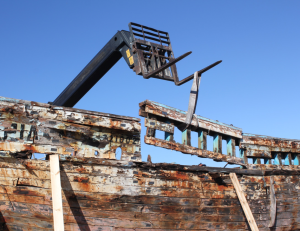
A portion of the bulwark of the Agios Spyridon Trawler being cut and removed from the boat. This and other portions of the boat are now stored at the storage facilities of the University of Cyprus in Nicosia (Photo: Georgia Kyriakou; © MARELab).
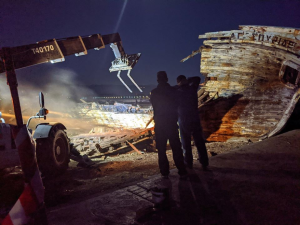
The final dismantling of the Agios Spyridon Trawler (Photo: Irene Katsouri; © MARELab).
Further info: https://www.ucy.ac.cy/marelab/en/research/traditional-boats
https://www.facebook.com/AgiosSpyridonProject
PRELIMINARY APPLICATION IDEA
The Agios Spyridon Project produced a thorough recording of the boat. A large amount of video-photographic and 3D data has been created, allowing a complete 3D reconstruction of the boat. Building on such data, the application idea consists of a 3D glossary of ship construction features. A longitudinal section (along the keel) of the photogrammetric 3D model of the Agios Spyridon Trawler will be used as a basis to display shipbuilding parts. These will be annotated with numbers identifying the specific shipbuilding feature. The textual part of the glossary will provide the name of the feature and a description/definition, based on published glossaries. The glossary will be in four languages: Greek, English, Italian, French. A 2D plan of the boat will also be part of the glossary displaying the location of all the features of the same name (for instance all the floor timbers). Finally, the application will be completed by a 3D viewer where an individual 3D model of the shipbuilding feature will be available for visualization and inspection.

Last Updated on June 24, 2022

