
Nissia is a shipwreck of the Ottoman period, located in the Nissia area, at the Famagusta cape, 28 metres below sea level. It is the only known shipwreck of that age in Cyprus, and one of the few that are being excavated in the Eastern Mediterranean. The shipwreck was known among divers since the 1980s, when diving activity started to develop in the area. However, the official reporting of the site to the DoA was made in 1992.
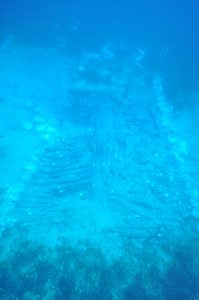
A view of the Nissia shipwreck site (Photo: Andreas Kazamias; © MARELab).
Since then, several attempts have been made to survey the site, with no follow up: In 1994, a team from the Ephorate of Underwater Antiquities of Greece visited the site, while in 2004 the private company Aquatec, in collaboration with the German Institution DEGUWA made attempts to survey and protect the site. Gradually, during these years, knowledge of the site became widespread among the diving community.
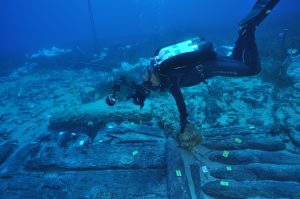
A diver taking photographs for the photogrammetry documentation of a portion of the Nissia shipwreck site (Photo: Andreas Kazamias; © MARELab).
Due to its location, at a depth easily accessible to divers, and the ‘friendly’ waters of the area, it was transformed into an uncontrolled recreation spot. This resulted in its deterioration and looting, and the subsequent loss of valuable archaeological evidence. The site was preliminary inspected by MARELab in 2012.
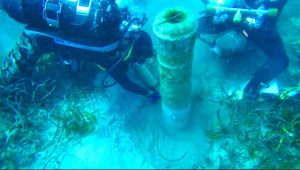
One of the cannons at the Nissia shipwreck site being excavated (© MARELab).
A first excavation field season was undertaken in September 2014, two trenches were opened. One was in the area at the NE end of the site where an isolated cannon was located.
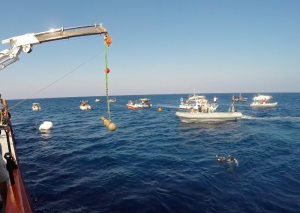
One of the cannons at the Nissia shipwreck site being lifted (© MARELab).
The cannon was lifted and has undergone conservation at the Conservation Laboratory of underwater archaeological material of the Department of Antiquities.
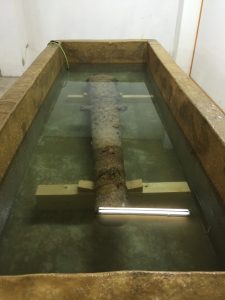
The cannon lifted from the Nissia shipwreck site undergoing conservation at the Conservation facilities of the Department of Antiquities in Larnaca (Photo: Anna Demetriou; © MARELab).
The second trench was opened in the east extremity of the main concentration, tangent to the other two visible cannons of the shipwreck. The site was documented in collaboration with the Department of Civil Engineering and Geomatics, the Cyprus University of Technology (under the direction of Dr. Dimitrios Skarlatos), using 3D digital photogrammetry methods.
Further info: https://www.ucy.ac.cy/marelab/en/research/nissia-shipwreck
PRELIMINARY APPLICATION IDEA
The research at the Nissia shipwreck site has led to valuable insights both on the shipwreck itself and on the material culture preserved. One of the cannons discovered was lifted from the site, conserved, and stored at the Department of Antiquities storage facilities in Larnaca . Relevant information related to the manufacturing, deployment, sinking and post-depositional life of the cannon are known thanks to historical and archaeological research. The application idea consists of a 2D animated storytelling focusing on the biography of the cannon discovered and raised from the shipwreck site. The 2D animated storytelling will explore the known events that have characterized the biography of the cannon. Some aspects of this biography known from solid archaeological and/or historical evidence will be treated as facts, while other aspects of the biography (for instance the cannon deployment on board, the potential employment on a sea battle) will be treated as abstracts and/or hypothetical events.

Last Updated on June 24, 2022

