
StoryPharm Fellows at the Colloquium in Byzantine and Medieval Studies University of Cyprus
February 10, 2026
StoryPharm Spring School
March 9, 2026Figure 1: Cambridge, Corpus Christi College, MS 190 (Penitential of Theodore), ca. 1000–1099
A penitential manuscript from Exeter (UK) that classifies sexual transgressions under normative categories and assigns penances according to repetition and severity.
Image courtesy of the Parker Library, Corpus Christi College, Cambridge (CC BY-NC 4.0).
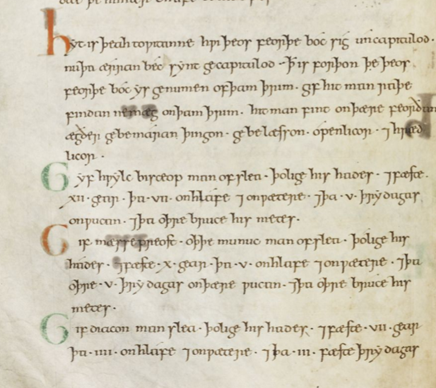
Figure 1: Cambridge, Corpus Christi College, MS 190 (Penitential of Theodore), ca. 1000–1099
A penitential manuscript from Exeter (UK) that classifies sexual transgressions under normative categories and assigns penances according to repetition and severity.
Image courtesy of the Parker Library, Corpus Christi College, Cambridge (CC BY-NC 4.0).
Making Desire Intelligible: Male-Male acts and Moral Language in Medieval Christianity
StoryPharm Blog 8 (February 2026)
Pablo Crovetto
StoryPharm Doctoral Fellow, University of Bamberg
In the Middle Ages, people did not speak about sexual desire in the way we do today. In fact, in many sources, sexual matters remain silent. Yet in contexts where discipline and confession were at stake, certain forms of sexual behaviour had to be named so that they could be regulated. This was the case, for instance, with male-male sexual acts. By looking closely at the words used to name and classify these acts, we can trace the moral and theological framework through which they were made intelligible.
Penitential texts are especially instructive in this regard, as historians such as Pier J. Payer have demonstrated (Payer 1984). Penitentials were practical handbooks used by confessors to assign penance for specific sins. Circulating widely between the sixth and twelfth centuries, they list offences alongside the fasting, exclusion, or other disciplinary measures deemed appropriate. Designed to guide confession and penance, they catalogue conduct in order to render it administrable. More often than not, forms of sexual behaviour are grouped and assessed under stable headings. One of the most significant headings is contra naturam. The term does not name a specific act, but marks a fundamental misalignment between desire and the order it was believed to violate. For a modern reader, this appeal to ‘nature’ may invite questions like: what kind of nature is at stake, and by whose standards is alignment measured? In this context, natura does not refer to biological processes or lived experience in a modern sense, but to a moral and teleological order in which bodies, desire, and acts are evaluated according to their presumed end: procreation.
What kinds of acts were gathered under the heading contra naturam? Penitential texts do not define the category, but populate it with examples. Among the practices most frequently included are sexual acts between men. The terminology used to refer to them varies. The Penitential of Finnian (c. 6th c.), one of the earliest surviving examples of the genre, refers to men ‘fornicating from behind,’ a circumlocution that signals the act without fully narrating it. The phrasing is formulaic rather than descriptive, reflecting the handbook’s concern with classification. Other texts employ the term sodomitae, invoking the biblical story of Sodom as a shorthand for grave sexual transgression. The association is sometimes reinforced through scriptural citation, most notably Leviticus 20:13: ‘Whoever has lain with a male as with a woman, both have committed an abomination’. In such formulations, biblical authority and penitential discipline converge, reinforcing classification through scriptural precedent.
These references do not construct an identity category in the modern sense. They designate acts, and they do so within a framework in which deviation from the procreative order is treated as moral disorder. Same-sex acts appear here as instances of conduct measured against a theological understanding of nature. The terminology used makes it possible to register the act without fully narrating it. Naming occurs, but within tightly controlled boundaries.
This dynamic becomes particularly visible in eleventh-century reformist writing, where imagery drawn from illness is used to intensify moral condemnation. In the work of Peter Damian (1007–1072), a Benedictine monk, cardinal, and prominent voice associated with the Gregorian reform, same-sex sexual acts are figured through images of corruption, infection, and decay. Writing in the context of clerical reform, Damian framed these acts not only as personal failings but as threats to ecclesiastical integrity. At its most extreme, Damian names sodomy a cancer: a hidden growth that spreads, contaminates, and threatens the integrity of clerical and communal life. This imagery transforms these acts into an urgent danger that demands decisive intervention. Strikingly, this rhetorical escalation often coincides with a refusal to specify acts in detail. Desire is depicted as overwhelming and destructive, yet its concrete forms remain largely unnamed. Illness imagery absorbs what is unsaid. The reader is left in no doubt about the gravity of the problem, even as its precise content remains opaque.
This opacity is not a failure of description. It is a technique. By refusing explicit articulation, medieval authors maintain control over how desire is imagined. The category of sickness stabilises moral anxiety by fixing deviation as a stable condition. What matters is not the variability of experience, but the certainty that something is fundamentally disordered. In this sense, the grammar of sickness functions as a form of closure. It halts inquiry by assigning desire a place within an already established moral ontology.
Seen from this angle, medieval discourses of illicit sexual desire do not simply condemn. They organise behavior and desire into categories that make them legible within a moral and theological order. They transform unease into classification and fear into diagnosis. The language of illness makes desire legible within a system that prioritises a certain order and hierarchy of the world. It also reveals the cost of such legibility: desire becomes something approachable through the grammar of pathology.
Something worth noting in these texts is the relative absence of psychological interiority. Medieval authors do not ask why a person desires in a particular way, nor do they explore desire as an expression of selfhood. Instead, they evaluate conduct according to its relation to an external pre-given order. The body is read teleologically; its meaning lies in its purpose.
What emerges from these texts then is not a psychology of desire, but a moral cartography. Sexual acts are positioned within a structured cosmos in which order, hierarchy, and purpose determine intelligibility. To describe something as a vice or as a form of sickness was not merely to condemn it, but to situate it within a network of discipline, correction, and theological meaning.
Historical distance does not collapse past and present, but it allows certain mechanisms to become visible. Medieval classifications show how moral worlds are stabilised through vocabulary. When a practice is named as vice, deviation, or sickness, it is inserted into a framework of explanation that circumscribes how it can be interpreted. Attention shifts from ambiguity to order, and from uncertainty to diagnosis.
The distance between the medieval world and ours is significant, especially in the moral and conceptual frameworks through which sexual desire is understood. Yet medieval texts remind us that naming is never neutral. Reflecting upon them sharpens our awareness of how language frames disturbance. Categories do more than describe; they organise how certain forms of sexual conduct are perceived within a moral order. They channel attention toward some aspects of conduct while obscuring others. They also shape how sexual behaviour and desire themselves can be understood and discussed. The question, then, is not only what is being named, but how the naming itself governs understanding.
References
Payer, P. J. 1984. Sex and the Penitentials: The Development of a Sexual Code 550−1150. Toronto: University of Toronto Press.


StoryPharm has received funding from Horizon Europe Programme for Research and Innovation under the action Horizon MSCA Doctoral Networks, Grant Agreement No. 101169114 and the UK Research and Innovation with Grant Ref: EP/Z534523/1


Anna Komnene’s Alexiad (12th-century manuscript). Biblioteca Medicea Laurenziana, Florence. View source


