
Abstract
Energy consumption of buildings, both residential and commercial, accounts for 20-40 % of the total energy used in developed countries. Most of the energy consumed by buildings is associated with heating and cooling needs. External walls account for 29%-59% of thermal loss occurring in buildings. Furthermore, 13% of the energy consumed by buildings results from wall manufacturing and construction processes (e.g. transportation of products, on-site equipment and human resources and on-site waste materials). Therefore, it is evident that, the characteristics of such systems pose a significant influence on construction sustainability. Subsequently, modern building regulations impose rather strict energy performance requirements that common construction systems often fail to satisfy. Studies show that, although certain construction typologies exhibit sufficient thermal performance, the overall sustainability of these systems is questionable due to their high embodied energy.
Therefore, the development of novel masonry bricks with enhanced characteristics has been widely considered for the construction of sustainable masonry and walling systems. Indeed, several studies exist on the design of masonry bricks with enhanced thermo-physical properties, reduced production energy consumption and/or improved construction techniques. Their novelty lies either in their composition and/or geometry, or in their ease of production/construction. For the evaluation of the proposed units and systems, alternative methodologies with quantitative and qualitative performance parameters are considered. A review of the literature has shown that most researchers target solely the optimization of a certain characteristic (e.g. of thermal properties or of embodied energy), rather than aiming at the balance between all aspects of functional response. As a result, innovative masonry bricks with improved thermal performance, but with limited compressive strength or questionable embodied energy is often proposed. Other solutions focus on ergonomics and construction time, without an in-depth analysis of the structural, thermal, and environmental response of the system.
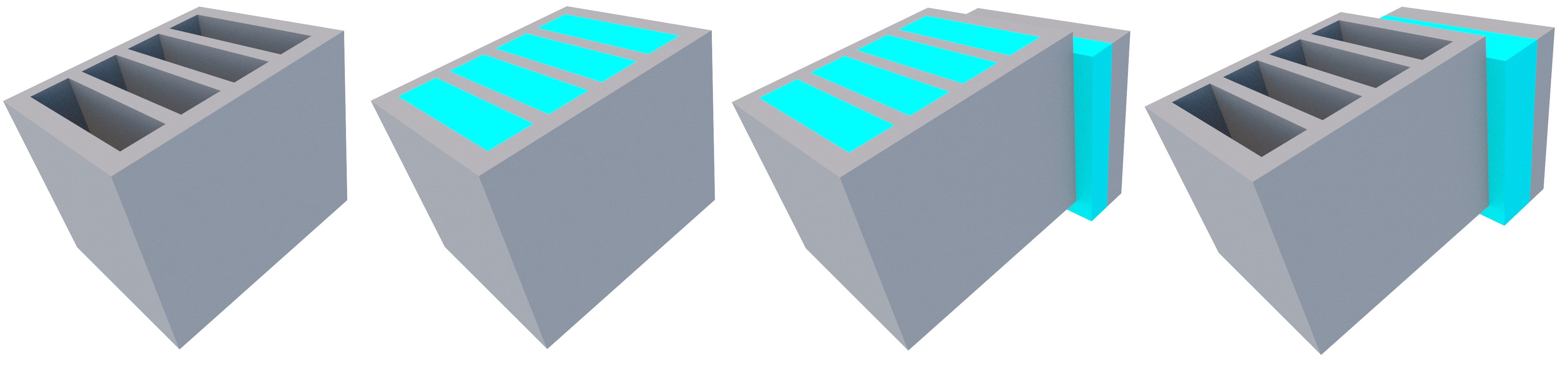
Considering the above, this study aims the development of a novel environmentally friendly masonry brick for the construction of sustainable masonry systems. An integrated assessment methodology is proposed and followed for the development of the proposed brick. The assessment methodology adopts a series of quantitative criteria for evaluating the overall performance of the proposed brick and more specifically in terms of thermal, environmental, and structural performance. Experimental investigation, analytical models and numerical simulations will be carried out to determine the adopted performance criteria. Also, qualitative criteria are adopted for various aspects affecting sustainability, that cannot be easily quantified and/or for which data are not available, including constructive performance and architectural expression. The proposed masonry brick will offer an alternative solution to typical masonry units encountered nowadays with great potential to enter the market. The implemented design strategy will demonstrate the significance of using a comprehensive approach in the process of designing construction components, and hence in the creation of sustainable built-up spaces.
Publications
- Kyriakidis, A., Illampas, R. and Michael, A., 2020. Parametric investigation for the improvement of the overall sustainable performance of an innovative masonry wall system. Procedia Manufacturing, 44, pp. 286-293.
- Kyriakidis, A., Michael, A., Illampas, R., Charmpis, D.C. and Ioannou, I., 2019. Comparative evaluation of a novel environmentally responsive modular wall system based on integrated quantitative and qualitative criteria. Energy, 188, p. 115966.
- Kyriakidis, A., Michael, A., Illampas, R., Charmpis, D.C. and Ioannou, I., 2018. Thermal performance and embodied energy of standard and retrofitted wall systems encountered in Southern Europe. Energy, 161, pp. 1016-1027.
- Illampas, R., Kyriakidis, A. and Michael, A., 2017. Computational evaluation of the thermal, environmental and structural performance of an innovative masonry system. Procedia environmental sciences, 38, pp. 812-820.
- Kyriakidis, A., Michael, A. and Illampas, R., 2016. Parametric numerical assessment of the energy efficiency and the environmental impact of an innovative masonry construction component. Journal of Sustainable Architecture and Civil Engineering, 16(3), pp. 6-19.
Last Updated on March 26, 2026

