
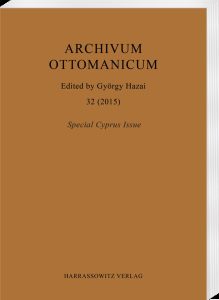
Archivum Ottomanicum, Special Cyprus Issue, vol. 32
Michalis N. Michael (ed.)
During the last few years, Ottoman Cyprus has become an attractive research field for historians of the Ottoman Empire. Various studies reflect the current interest in researching and analysing all three centuries of the Ottoman period, and the reality of this era is surfacing. More importantly, new questions are now being asked, questions that overcome the simplistic structures of the traditional historiography on Ottoman Cyprus. Scholars are now dealing with questions relating to how Cyprus can be accommodated in the broader Ottoman and international reality of each era. An important element of modern historiography on Ottoman Cyprus is the widespread usage of Ottoman sources accompanied by other primary sources, both local and sources outside Cyprus, and they present the events in Ottoman Cyprus with substantial documentation. This alone makes the interpretation of the historic developments on the island more complete and, in any case, closer to the reality revealed by the Ottoman sources. The topics examined in the articles included in this special issue vary and are concerned with many different aspects of Ottoman and Cypriot history. A key criterion for these studies is the use of primary Ottoman sources; this is done in an effort to bring to light the realities on the island as these are related in the database of the Ottoman archives, while also placing new research questions. These studies have been included in the volume chronologically in an effort to give an account of as many issues concerning the different periods of Ottoman Cyprus's history.
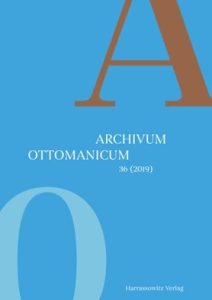
Archivum Ottomanicum, Special issue: The Muslim/Turkish community of Cyprus and the transition from the Ottomans to the British, vol. 36
Michalis N. Michael, (ed.)
This volume aims to study the Turkish Cypriots from 1856 to 1931, trying to illustrate the process through which, during these crucial years for the history of Cyprus, the island’s Muslim-Ottoman community is shaped into a Turkish Cypriot community. Articles will study four main periods: 1. The 19th century “Ottoman modernity” and its consequences for the Muslim population of Cyprus, most notably the transformation of an Ottoman power group into a religious community; 2. The first period of the implementation in Cyprus of “British modernity” (1878-1914) and the different tendencies that develop within the Muslim community as a result of the changes that the British rule brings to the island; 3. The second period of “British modernity” (1914-1925) and the social, political and demographic transformations that it brings: from an Ottoman-Turkish to a Turkish community; 4. Cyprus as a British colony (1925-1931) and the radicalization of social and political forces within the Turkish community in conjunction with the creation of a Turkish nation-state and with the growing radicalization of the Greek Cypriots. Of course, developments within the Muslim/Turkish Cypriot community will be studied in interaction with developments within the Greek-Orthodox/Greek Cypriot community all through the period under discussion (1856-1931).

Turkish Historical Review, Special Issue: The Multiple Readings of Ottoman History in Modern Turkey, vol. 13
Michalis N. Michael, (ed.)
As the needs of different ideopolitical powers of the present vary, they often require different readings of the same history, while aiming to formulate specific frameworks for the present and the future. In essence, this implies that history may be used ideologically; this process entails that historical facts, as well as history as a whole, can be at times isolated from their historical framework to be repositioned or reorganized in the framework of present needs in an effort to create the necessary historicity for the present. In this type of process, the ruling ideology, and mainly the political authorities in power, may sort history, recompose it and familiarize themselves with the past in their own way. The historical fact, however, in the manner that it is represented in the present, by becoming a mythical narrative, explains more about the present rather than the past. As Michel de Certeau notes, behind the representation of the past, the present which is reshaping the past is hiding. Taking into consideration that history may be used as detailed above, the studies in this issue undergo the effort to analyse the various readings of Ottoman history from the various ideological and political powers in Tukey in the twentieth and twenty-first century. The aim is to offer studies on the multiple readings of Ottoman history by the different ideological and political powers of modern Turkey, readings which contributed to the formulation of a specific present with the goal to create a specific future. The articles in this special issue cover the different readings of Ottoman history by the Turkish political powers, either from the Kemalist period or the period of political Islam

Analyse des polémiques identitaires et de la conflictualité dissimulées, Revue de sémio- linguistique des textes et des discours (Semen)
Fabienne Hélène Baider, M. Constantinou
Les contributions de ce numéro ont pour objectif d’analyser et de déconstruire les processus langagiers explicites ou implicites d’exclusion, d’insulte et d’oppression de la part de différents groupes sociaux (familles, internautes, institutions, groupes politiques) envers des individus qui souvent incarnent la différence. Adoptant des approches théoriques et méthodologiques différentes, elles cherchent à interroger tant les manifestations discursives de la haine dissimulée que les discours y répondant. Trois contributions explorent la haine dissimulée dans les discours politiques, institutionnels ou médiatiques (Sapio, Lorenzi-Bailly et Guellouz, Bouzereau), trois autres analysent des initiatives de contre-discours et de discours alternatifs ( Renaut et Ascone, Varga, Moïse et Hugonnier ).
Narrating hostility, challenging hostile narratives, Lodz Paper in Pragmatics 14
Fabienne Hélène Baider, Kopytowska, M
The concept of hate speech as a speech against a particular community because of its (perceived) specific characteristics has been adopted in most Western countries, featuring in international and national legal frameworks as well as codes of conduct for media practitioners. With politicisation of ethnicity, religion and sexuality, enhanced by political, social and economic crises around the world, including migration, terrorism and violent extremism, it has recently become more salient, contested and divisive.1Yet, as observed by Technau (this Special Issue), even if the expression is new, the concept itself is not. Various terms have been used to refer to the phenomenon; in the US context, for example, “race hate” was in use in the late 1920s and early 1930s, “group libel” in the1940s, “bias crime” in the 1970s, with “racist speech” or “hate speech” becoming common in the 1980s” (Walker 1994: 8).

Developmental, Modal, and Pathological Variation—Linguistic and Cognitive Profiles for Speakers of Linguistically Proximal Languages and Varieties
Grohmann, Kleanthes K., Maria Kambanaros, and Evelina Leivada (eds.)
The cognitive benefits of bilingualism have an impact on the processing mechanisms active during language acquisition in a way that results in language variation. Within bilingual populations, the notion of language/linguistic proximity is also of key importance for deriving variation. Sociolinguistic factors can also invest the process of language development and its outcome with an additional layer of complexity, such as schooling, language, dominance, competing motivations, or the emergence of mesolectal varieties which blur the boundaries of grammatical variants. This is particular relevant for diglossic speech communities—bilectal, bidialectal, or bivarietal speakers. A clear goal of the present Research Topic is to address whether the bilingual advantage extends to such speakers as well.

Apprentissage des langues : compétence pragmatique, interculturalité, Revue Le Langage et l'Homme 551
Fabienne Hélène Baider, Cristelle Cavalla, Georgeta Cislaru
Since the 1990s, research in language didactics has turned to pragmatics to renew teaching, assessment and learning methods (Fulcher, Davidson, Kemp 2011). Working in pragmatics and language learning means considering language in its discursive, communicative and social dimension, which leads to the rapid integration of the notion of pragmatic competence. At the origin of the field of investigation, comparative studies on the differences and similarities between language acts (Austin 1962) according to languages and cultures, their socio-pragmatic variations and the variation of interlanguage were at the heart of large-scale projects such as the "Cross- Cultural Speech Act Realization" (CCSARP) (Blum-Kulka, House, Kasper 1989). This volume focuses on the social, identity and cultural dimensions in the acquisition of pragmatic competence in learners.

La parité linguistique, Nouvelles Questions Féministes vol. 26/3, 10
Fabienne Hélène Baider, E. Khaznadar and T. Moreau
Le symbolisme social étant véhiculé et structuré par le langage, c’est toute une conception du monde qui est impliquée dans cette question. L’utilisation du masculin dit “générique” n’est pas remise en question alors qu’elle biaise systématiquement la représentation sociale des femmes. Ainsi la parité linguistique, la construction de systèmes de savoirs non discriminatoires, l’utilisation du féminin et du masculin pour toutes les dénominations humaines, la reconnaissance effective des femmes dans le discours social, sont des instruments indispensables dans la conquête d’une réelle égalité
Hate speech: definition, interpretations, practices, Pragmatics and Society
Fabienne Hélène Baider, S. Millar, S. Assimakopoulos
This article argues for a definition of online hate speech as a contextualised speech act that is part of a social process of alienation. It suggests that hate speech comes in degrees, is contextual, involves already existing power dynamics, and ‘others’ its targets by creating in/out groups. I first review the various stances towards understanding the phenomenon of online hate speech, including approaches that focus on online hate speech as an interaction shaped by its medium, while also emphasizing the need to consider the role of implicatures in speech acts when defining hate speech. Second, I argue that the relationality of online speech implies that any message is embedded in idiosyncratic socio-cultural norms, and that therefore a ‘one size fits all’ definition of hate speech is elusive. I conclude by suggesting that contextualized hate speech is embedded in a social process of alienation and should be understood as a continuum.
(Im)-politeness and Intercultural Pragmatics. Corpus Pragmatics
Fabienne Hélène Baider, G. Cislaru
This special issue focuses on the im/politeness and intercultural communication interface and explores several crucial areas such as Historical pragmatics, Forensic discourse, Impoliteness, etc. The authors’ choices of analytical frameworks range from a Frame-based Approach to Experimental Pragmatics, to mention but two. The shared aim is to understand the functioning or value of certain pragmatic or linguistic units in different interactional and situational contexts, taking into account the forms of circulation of discourse and/or phenomena related to what is at stake in the exchanges. Whether from a comparative angle or from monolingual perspectives, the contributors deal with the way im/politeness manifests itself in diachronic and/or synchronic contexts.

Language, History and Society, Women in French Studies 10
Fabienne Hélène Baider, F. Chevillot
Special Section. Introduction Langue, société et littérature : sage-femme ou femme-sorcière? Fabienne Baider. A ces êtres inconnus qui ne nous ont laissé de trace dans l'histoire qu 'en y laissant leur peau.
Last Updated on 30 Μαρτίου, 2026

