
![[i]Treatise on Herbs[/i] ([i]Tractatus de herbis[/i], 13th/14th c. Italy) Egerton 747 (f. 12r), British Library, London](https://www.ucy.ac.cy/storypharm/wp-content/uploads/sites/316/2025/07/blog2-150x150.jpg)
What is a Pharmakon?
July 30, 2025
StoryPharm Training in Critical Discourse Analysis
September 9, 2025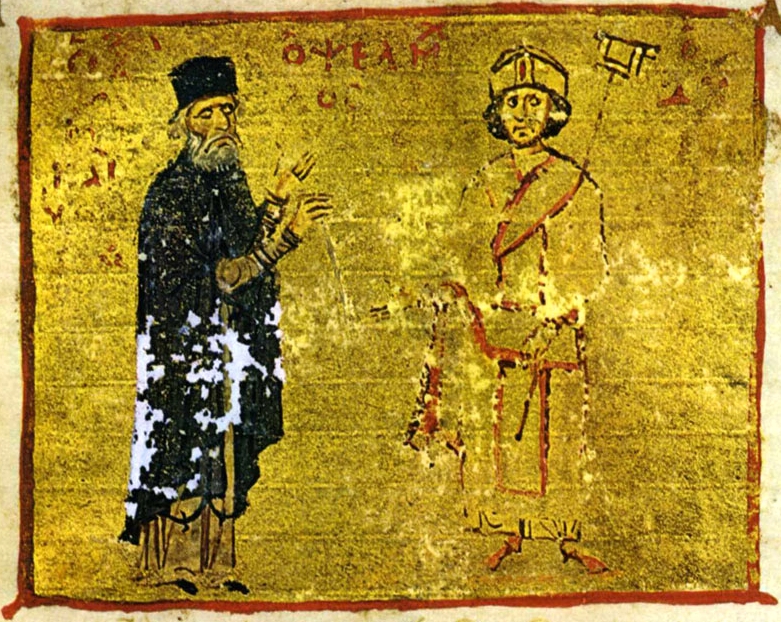
Michael Psellos (left) with his student, Byzantine Emperor Michael VII Doukas
Codex 234, f. 245a, Mount Athos, Pantokrator Monastery, 12th/13th c.
(source)

Michael Psellos (left) with his student, Byzantine Emperor Michael VII Doukas
Codex 234, f. 245a, Mount Athos, Pantokrator Monastery, 12th/13th c.
Psellos and Friends: Discourse Analysis and Byzantium
StoryPharm Blog 3 (August 2025)
James Gilmer
StoryPharm Doctoral Fellow, Cardiff University
‘Byzantine’ has been employed as a pejorative term that evokes unnecessary complexity and the arcane. As I work more and more with Byzantine texts, I am keenly aware of the clever rhetorical ploys and concealed meanings that make chronicles from the time ‘Byzantine’ in both senses of the word. Meaning was often deliberately concealed behind ‘deep-cut’ references to ancient sources that were intended to slip past the notice of most audiences and only find appreciation among a select few, as authors often found themselves eager to express deeply held but unorthodox views. By employing the theoretical framework of discourse analysis, I hope to delve deep beyond the surface meaning presented by Byzantine authors and extract the deeper, intertextual, and contextual arguments embedded in these texts and to better understand how Byzantine authors constructed authority, navigated power structures, and conveyed meaning.
Discourse analysis offers a framework and a set of analytical lenses for evaluating primary sources. James Gee argues that ‘to understand anything fully you need to know who is saying it and what the person saying it is trying to do’, and I feel this frames my understanding of discourse analysis quite well (Gee 2014: 8). As I analyse the chronicles and hagiographical accounts left by the Byzantines, I will need to consider the motives of my authors very carefully. Understanding what my sources are saying will be a vital portion of my research, especially when considering authors like Michael Psellos, who Anthony Kaldellis describes as an author with a tendency to ‘speak out of both sides of his mouth’ (Kaldellis 2009). With Psellos and other Byzantine chroniclers, I will need to be wary of the constraints placed upon each author by societal norms and official censorship.
Beyond questioning the transparency of my sources, the techniques of discourse analysis will encourage me to consider the purpose(s) that motivate the authors of my sources to write at all. Choosing to write down one’s ideas – particularly political ideas in an environment with a fairly strict idea of orthodoxy and harsh penalties for those who defy orthodoxy – implies conscious choice and an objective that these authors held dear yet may have deliberately obscured. Gee notes that ‘people fight over what the “rules” for being a “good student” ought to be. They sometimes seek to change them or to agree to a new set of “rules”. They fight over these things because important social goods are at stake’ (Gee 2014: 12). Each of the major chronicles that I intend to work with in my research is an intrinsically biased source that is itself an argument that each chronicler chose to make. Michael Psellos (11th c.) presents a narrative on Byzantine political theory; Michael Attaleiates (11th c.) writes in direct response to Psellos, offering a critique of Psellos’ views; John Skylitzes (11th c.) summarises the work of both but adds a pro-Komnenos spin to the narrative; Anna Komnene (12th c.) and her husband Nikephoros Bryennios (12th c.) write in the same tradition, but with a clear goal of exalting their respective families (Kaldellis 1999; Kornberger 2019; Krallis 2012; Neville 2012; Buckley 2017).
Each of these historians has an agenda; disentangling biased reporting to uncover historical facts is a substantial task, and one which the theoretical framework of discourse analysis will make easier. Gee argues that discourse analysis seeks to understand the conversations surrounding major points of political disagreement in our own society, emphasising the intrinsically political nature of language and discourse. He notes that social goods are the stuff of politics. Politics is not just about contending political parties. At a much deeper level, it is about how to distribute social goods in a society: who gets what in terms of money, status, power, and acceptance on a variety of different terms, all social goods. Since, when we use language, social goods and their distribution are always at stake, language is always ‘political’ in a deep sense (Gee 2014: 13).
Each of the major chronicles that I will work with are inherently political works in one sense or another. Psellos, Attaleiates, and Skylitzes each write with an eye towards securing employment on the merits of their prose and rhetoric and obtaining a share of ‘social good’ for themselves; on a less mercenary level, each chronicler is also engaged in discourse related to the distribution of wealth and allocation of resources within the imperial government more broadly (Bernard 2017: 37).
Gee argues that discourse analysis seeks to answer the question of ‘who-doing-what’, which he frames as ‘social language’ (Gee 2014: 71). As I work through my sources, ‘who-doing-what’ will provide a vital framework for understanding the rhetorical work that each author engages in to deliberately build a trustworthy and persuasive – but artificial – persona. Alexiad provides a perfect example, as Anna consciously dons a variety of personas and leans heavily into established genre tropes to claim authority and legitimacy for what is an inherently transgressive activity – a woman writing a historical account (Nevill: 2016). Each persona adds an additional layer to the construction of authority in her work, and unpacking this aspect of her writing is an essential preliminary step I must undertake before evaluating her account of historical events.
Philological analysis of texts lends itself very well towards an area of shared interest in discourse analysis and classics – intertextuality. Gee presents intertextuality as ‘cases where one oral or written text directly or indirectly quotes another text or alludes to another text or type of text in yet more subtle ways. Intertextuality is where different people’s words mingle and marry in a wide variety of ways’ (Gee 2014: 69). Byzantine sources are rich with intertextual references to classical texts, building upon and incorporating the work of familiar authors like Homer, Herodotus, and Thucydides to lend authority and legitimacy to their own works. As Kaldellis has ably pointed out, clever use of intertextual connections presented an opportunity for Byzantine authors like Prokopios to register discontent with contemporary rulers – enabling Prokopios to ‘speak out of both sides of his mouth’ as well (Kaldellis 2004 and 2009). Intertextuality is the key to understanding how a Byzantine author could navigate multiple roles and speak to multiple audiences within the same text and with the same words. Intertextuality is therefore vital to understanding how my authors build credibility and legitimacy.
Discourse analysis provides a useful framework in which to consider the sources I will be working with holistically. It is often tempting to read these texts at a surface level and extract only what the author has explicitly said happened (or didn’t happen) in historical accounts; nevertheless, I have found that the most interesting and exciting insights into Byzantine sources often emerge from the clever, concealed meanings of intertextual relationships and the ideas that Byzantine authors could imply without explicitly expressing.
References
Bernard, F. 2017. ‘Authorial Practices and Competitive Performance in the Works of Michael Psellos’, in M. Lauxtermann and M. Whittow (eds) Byzantium in the Eleventh Century. London and New York: Routledge, 32–44
Buckley, P. 2017. The Alexiad of Anna Komnene: Artistic Strategy in the Making of a Myth. Cambridge: Cambridge University Press
Gee, J. 2014. An Introduction to Discourse Analysis: Theory and Method. London and New York: Routledge
Kaldellis, A. 1999. The Argument of Psellos’ Chronographia. Leiden and Boston: Brill
Kadellis, A. 2009. Hellenism in Byzantium: The Transformations of Greek Identity and the Reception of the Classical Tradition. Cambridge: Cambridge: University Press
Kaldellis, A. 2004. Procopius of Caesarea: Tyranny, History, and Philosophy at the End of Antiquity. Philadelphia: University of Pennsylvania Press.
Kornberger, F. 2019. ‘“O Most Divine Emperor”: Narrative and Political Ideology in Eleventh-Century Byzantium’. PhD dissertation submitted at the University of Birmingham
Krallis, D. 2012. Michael Attaleiates and the Politics of Imperial Decline in Eleventh-Century Byzantium. Tempe, Arizona: Arizona Center for Medieval and Renaissance Studies
Neville, L. 2012. Heroes and Romans in Twelfth-Century Byzantium: The Material for History of Nikephoros Bryennios. Cambridge: Cambridge University Press
Neville, L. 2016. Anna Komnene: The Life and Work of a Medieval Historian. Oxford: Oxford University Press


StoryPharm has received funding from Horizon Europe Programme for Research and Innovation under the action Horizon MSCA Doctoral Networks, Grant Agreement No. 101169114 and the UK Research and Innovation with Grant Ref: EP/Z534523/1

Anna Komnene’s Alexiad (12th-century manuscript). Biblioteca Medicea Laurenziana, Florence. View source
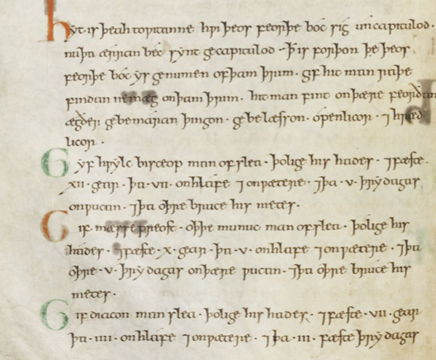
Figure 1: Cambridge, Corpus Christi College, MS 190 (Penitential of Theodore), ca. 1000–1099
A penitential manuscript from Exeter (UK) that classifies sexual transgressions under normative categories and assigns penances according to repetition and severity.
Image courtesy of the Parker Library, Corpus Christi College, Cambridge (CC BY-NC 4.0).

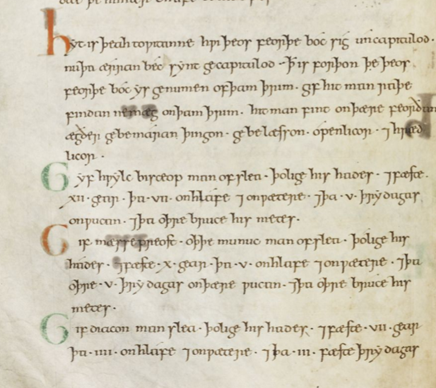

Figure 1: Illustration of a Pharmacy in the Italian Tacuinum sanitatis, 14th century by "Magister Faragius" (Ferraguth) of Naples – book scan of Tacuinum Sanitatis https://commons.wikimedia.org/w/index.php?curid=1638852