
Architectures and Learning Landscapes | Lucia Pierro & Marco Scarpinato - AutonomeForme

Abstract:
The talk proposes a reflection on the relationship between architecture and landscape and on the strategies for building a balanced relationship between humans and nature inside the learning spaces. Courtyards, educational vegetable gardens, outdoor sports spaces and patios organized as open air classrooms are learning landscapes in which "green pedagogy" builds an ecological and sustainable vision. These environments of exploration and learning facilitate an experiential and immersive understanding of the natural world and develops a meaningful and lasting environmental education. Learning landscapes strengthen the role of the school as a civic center open to the community and define new ecosystems capable of reconnecting identities, histories, cultures and landscapes. The learning landscapes can educate people to develops sustainably by allowing the growt of a community capable of learning cooperatively, of assuming care responsibilities towards the ecosystem in wich we are part.
Speakers:
Lucia Pierro Marco Scarpinato AutonomeForme
Date:
Thursday 02/03/23, 19:00 - 20:30
Location:
Room 013, Kallipoleos Ave. 75, 1678, Nicosia
Online Zoom meeting
Coffee Table: Notes and Reflections on Unexpected Trajectories | Francesco Garofalo & Jacopo Gennari Feslikenian - Openfabric

Abstract:
The lecture will unfold as a number of narratives in the form of a conversation. Spatial Songlines following different trajectories -sometimes apparently conflicting, which are the foundation of our work. Can a similar methodology be found in desert context and in Siberia? Can a consistent approach be preserved in a concrete tile as much as in a region? Can we design public spaces and at the same time our planet, and beyond, the outer space?
Speakers:
Francesco Garofalo Jacopo Gennari Feslikenian Openfabric
Date:
Thursday 23/02/23, 19:00 - 20:30
Location:
Room 013, Kallipoleos Ave. 75, 1678, Nicosia
Online Zoom meeting
Architectural Practice in the Age of Volatility | Michael Cosmas

Abstract:
We operate in a world of an exponentially accelerating speed of distribution of information; where technology is constantly reasserting our physical reality. Ιt is also a world of climatic crisis, continuous disruption and ever increasing volatility. In this emerging age of postmodern reality one quickly poses the question on how a bounded by locality architectural practice can remain relevant in its discourse, transcending local bounds and nomenclatures. How can a practice maintain rigour in its discourse and purpose in an agenda of architectural production for the new millennium?
Speakers:
Michael Cosmas
Date:
Monday 09/02/23, 19:00 - 20:30
Location:
Room 013, Kallipoleos Ave. 75, 1678, Nicosia
Online Zoom meeting
Partitions and Healing Spaces | Esra Akcan

Abstract:
After an overview of the presenter’s previously published work on the relation between migration and architecture, this lecture will explore the right-to-heal after massive mass migrations during nation-state formations as a topic of transitional justice. It will concentrate on the dissolution of the Ottoman Empire, including the “Exchange of Populations” treaty (1923) that divided the communities residing in thousands of villages and towns into two purified categories between Greece and Turkey, assuming the alignment of religion, nation and territory, regardless of the actual diversity of peoples, and whether there were hostile or peaceful relations on the ground. The lecture will expose the contrast between the declarations of state agents and international law diplomats on the one hand, and the experiences of those involved on both sides of the Aegean Sea on the other hand. It will discuss the residues of this historical wound today, by studying the practice of a handful architects, residents and stonemasons as a struggle toward healing through architecture.
Speakers:
Esra Akcan
Date:
Thursday 10/11/22, 19:00 - 20:30
Location:
Room 013, Kallipoleos Ave. 75, 1678, Nicosia
Online Zoom meeting
Architectural Methodologies | Marios Christodoulides (Simpraxis Architects)

Abstract:
The desire to reevaluate typologies, question programmatic and spatial norms, and formalize ideas are concerns that seem to transcend the different Architectural challenges we encounter. The specifics of site, client, scale, help us carry out these investigations, hopefully arriving at work that is both a product of our continuing concerns, but also unique and appropriate in responding to each specific Architectural problem we encounter. This approach has always been present in our quest to produce Architecture that spans from the creation of habitable spaces, cultural spaces to gather, and urban interventions. Projects that have always strived to elevate the user experience and raise the appreciation for our role as Architects in improving our way of life. This is a presentation of some of our projects that have helped to shape our way of thinking and that can hopefully demonstrate our methodologies in approaching each one of these projects, irrespective of scale and program.
Speakers:
Marios Christodoulides Simpraxis Architects
Date:
Thursday 03/11/22, 19:00 - 20:30
Location:
Room 013, Kallipoleos Ave. 75, 1678, Nicosia
Online Zoom meeting
Milieu, Unconstrained | Raviv Ganchrow
Abstract:
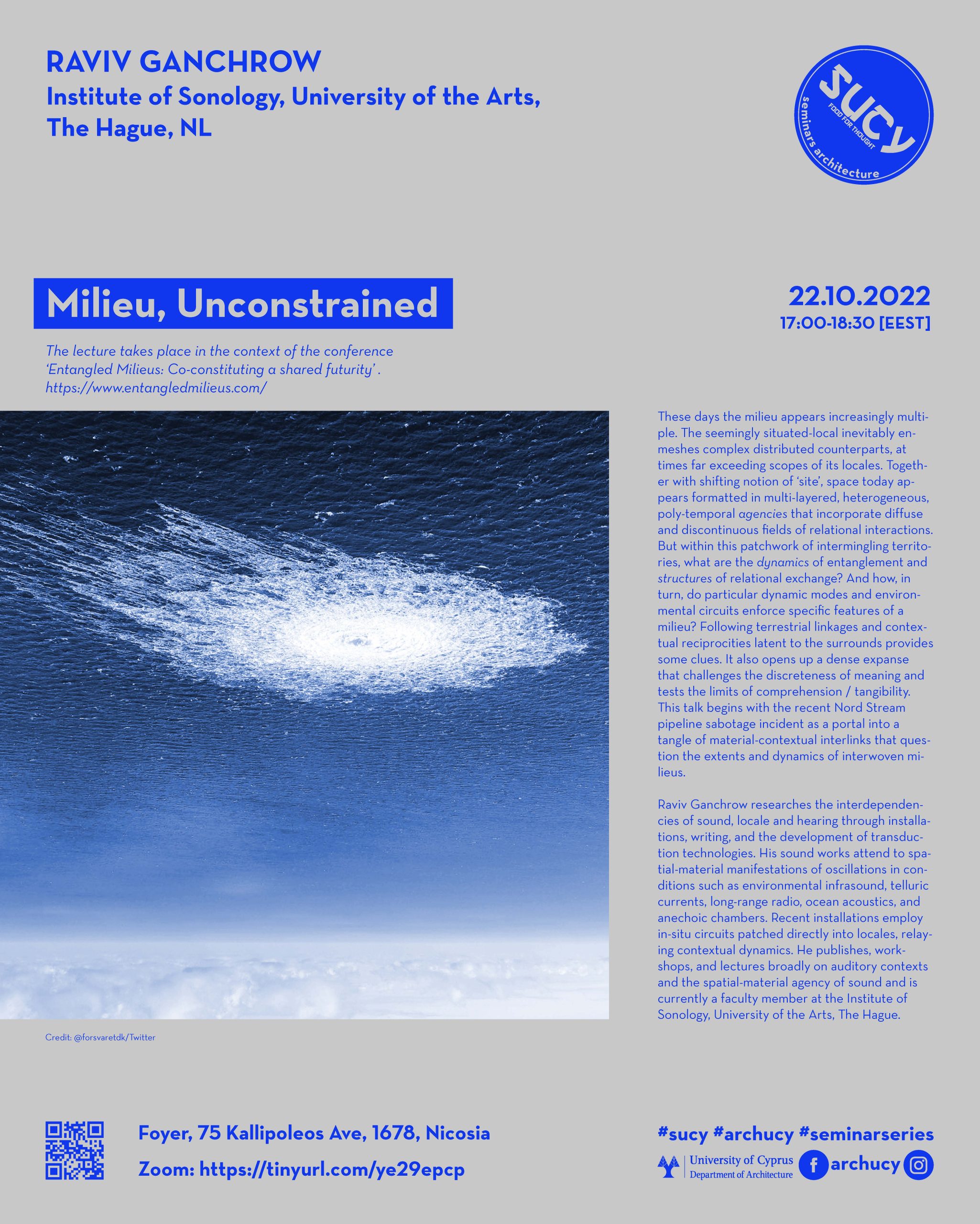
These days the milieu appears increasingly multiple. The seemingly situated-local inevitably enmeshes complex distributed counterparts, at times far exceeding scopes of its locales. Together with shifting notion of ‘site’, space today appears formatted in multi-layered, heterogeneous, poly-temporal agencies that incorporate diffuse and discontinuous fields of relational interactions. But within this patchwork of intermingling territories, what are the dynamics of entanglement and structures of relational exchange? And how, in turn, do particular dynamic modes and environmental circuits enforce specific features of a milieu? Following terrestrial linkages and contextual reciprocities latent to the surrounds provides some clues. It also opens up a dense expanse that challenges the discreteness of meaning and tests the limits of comprehension / tangibility. This talk begins with the recent Nord Stream pipeline sabotage incident as a portal into a tangle of material-contextual interlinks that question the extents and dynamics of interwoven milieus.
Speakers:
Raviv Ganchrow
Date:
Saturday 22/10/22, 17:00 - 18:30
Location:
Room 013, Kallipoleos Ave. 75, 1678, Nicosia
Online Zoom meeting
Second Life | Romain Lucas & Belén Ramos Jiménez
Abstract:
The project seeks to reveal all the heritage present in the territory of Roquetas de mar in order to give it an important place in the project “second life” To get this target, we propose an extended definition of patrimony that allows to highlight different existing elements such as heritage, local materials, daily practices, Poniente’s landscape, etc. Then we introduced those patrimonials elements in order to develop a city that can evolve and adapt itself according to the economic, demographic or ecological pressures that the territory has to face.
Speakers:
Romain Lucas Belén Ramos Jiménez
Date:
Monday 10/10/22, 19:00 - 20:30
Location:
Room 013, Kallipoleos Ave. 75, 1678, Nicosia
Online Zoom meeting
Climate Resilience and Food Equity in the Built Environment: Louisiana and New York City | Despo Thoma
Abstract:
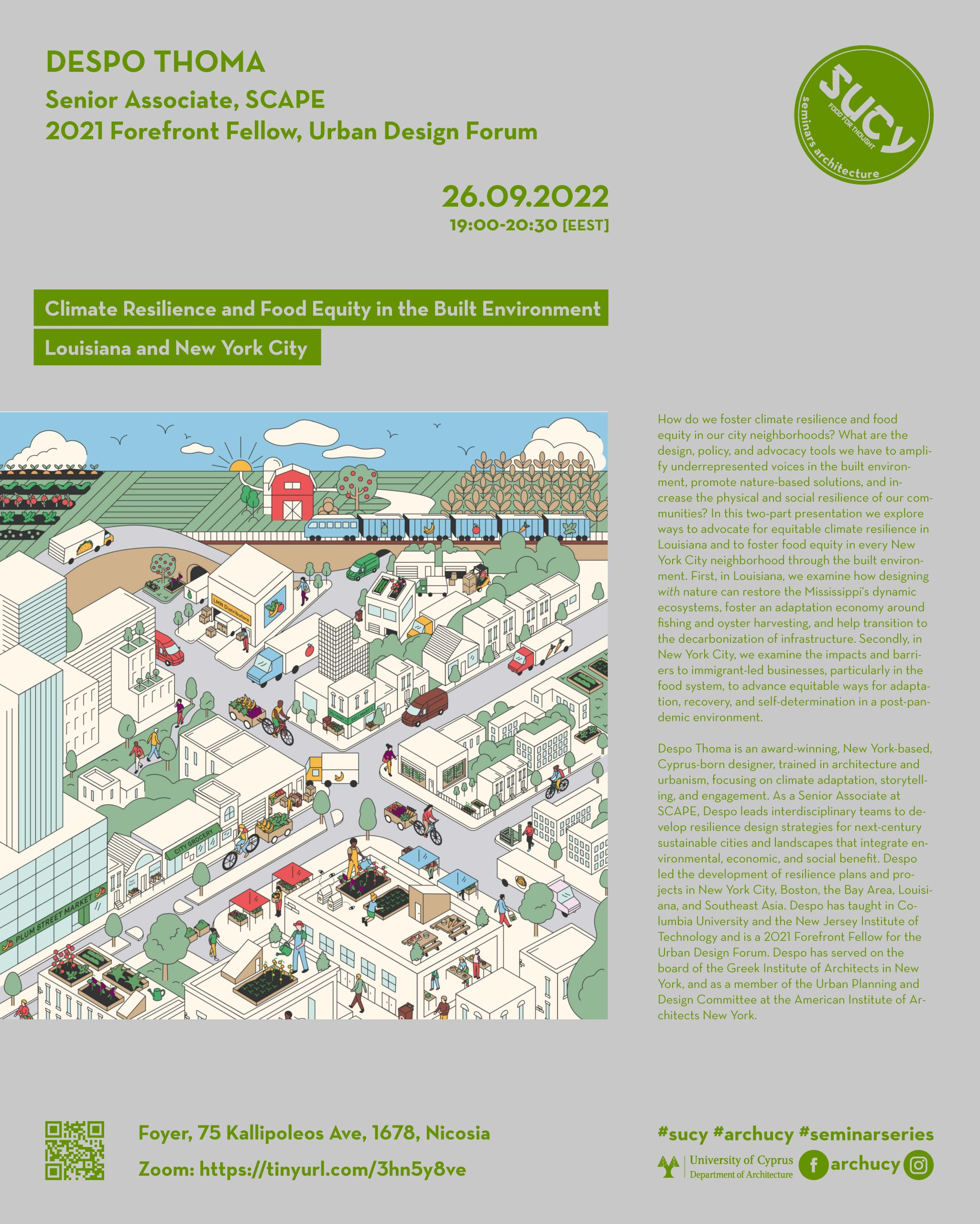
How do we foster climate resilience and food equity in our city neighborhoods? What are the design, policy, and advocacy tools we have to amplify underrepresented voices in the built environment, promote nature-based solutions, and increase the physical and social resilience of our communities? In this two-part presentation we explore ways to advocate for equitable climate resilience in Louisiana and to foster food equity in every New York City neighborhood through the built environment. First, in Louisiana, we examine how designing with nature can restore the Mississippi's dynamic ecosystems, foster an adaptation economy around fishing and oyster harvesting, and help transition to the decarbonization of infrastructure. Secondly, in New York City, we examine the impacts and barriers to immigrant-led businesses, particularly in the food system, to advance equitable ways for adaptation, recovery, and self-determination in a post-pandemic environment.
Speaker:
Despo Thoma
Date:
Monday 26/09/22, 19:00 - 20:30
Location:
Kallipoleos Ave. 75, 1678, Nicosia
Online Zoom meeting
Material Matters | Florian Musso

Abstract:
The lecture evokes the importance of materials in architectural creation based on the production of LorenzMusso architects.
Speaker:
Florian Musso
Date:
Thursday 22/09/22, 19:00 - 20:30
Location:
Kallipoleos Ave. 75, 1678, Nicosia
Online Zoom meeting
Last Updated on 26 Μαρτίου, 2026

